 Many Happy Returns
Transmission Date: 10/11/1967
Episode Length: 48'25m (DVD timing)/50'19m (Blu-Ray timing)
Est. Ratings: 10.3m
Written by: Anthony Skene
Directed by: Patrick McGoohan (Under the pseudonym Joseph Serf)
DVD availability: Try amazon.com
Production Commenced:
March 1967
Production Credits:
An ITC Production by Everyman Films Ltd. Executive Producer: Patrick McGoohan; Script Editor: George Markstein; Producer: David Tomblin; Production Manager: Bernard Williams; Director of Photography: Brendan J. Stafford B.S.C.; Art Director: Jack Shampan; Camera Operator: Jack Lowin; Editor: Geoffrey Foot G.B.F.E.; Theme: Ron Grainer; Musical Director: Albert Elms; Cameraman (2nd Unit): Robert Monks; Assistant Director: Ernie Morrie; Sound Editor: Wilfred Thompson; Sound Recordist: John Bramall; Music Editor: Eric Mival; Casting Director: Rose Tobias-Shaw; Continuity: Josie Fulford; Set Dresser: Kenneth Bridgeman; Make-Up: Eddie Knight; Hairdressing: Pat McDermot and Wardrobe: Masada Wilmot. Made on location and at Metro-Goldwyn-Mayer Studios, Borehamwood, England.
Starring:
Patrick McGoohan (The Prisoner); Donald Sinden (The Colonel); Patrick Cargill (Thorpe); Georgina Cookson (Mrs Butterworth); Brian Worth (Group Captain); Richard Caldicot (Commander); Dennis Chinnery (Gunther); Jon Laurimore (Ernst); Nike Arrighi(Gypsy Girl); Grace Arnold (Maid); Larry Taylor (Gypsy Man); Angelo Muscat (The Butler, uncredited) and Robert Rietty (Voice of No.2 in titles, uncredited)
Episode Order:
In presenting a "revised episode order", this site was attempting to redress what were clearly episodes screened out of order because they were already "in the can", while episodes needing post-production, clearly intended to be early episodes, were pushed only when they were ready by demanding networks.
One major error this site presented in 2007 was in having this episode come sixth in the run, simply because it featured two recurring actors. This was an affectation not in the spirit of this "episode order", which exists to try to make sense of the intended order of production, not enforce a narrative on the programme. So that while "Mrs. Butterworth" also appears in A. B. and C. as a different character, this isn't to be taken into account, as this happened all the time in ITC casting.
One small conceit I will allow is that this episode was produced immediately after Hammer Into Anvil, where Patrick Cargill got on so well with Patrick McGoohan that they wanted to use him again. Having him play a vicious and broken No.2, only to return the following week as another character would be far too much of a stretch even for audiences used to it, so the order will be flipped, with this the precursor to Many Happy Returns... only pushed back to 11th place.
No.6:
Gives his name as "Peter Smith" in this episode, though it's safe to assume this is a name he makes up on the spot rather than his actual name. We also discover that he built his kit car Lotus himself, and that it's engine number is 461034TZ. His house was rented, with a lease that had six months to go. Mrs. Butterworth (see "Storyline", below), took over the lease from an estate agent firm that was different to the one No.6 used, "Stombell and Croydon". In his house there was a patch of dry rot behind a desk, "made good about twelve months ago". The hot and cold taps on his shower were also fitted the wrong way round.
An old friend of his is introduced, The Colonel (the same Colonel mentioned in Dance of the Dead?) who has the Christian name of James, and describes No.6 as an "old, old friend". A mutual associate that has never met No.6 before is also present, Thorpe.
In The Village:
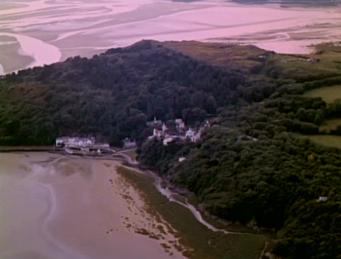
The Village has its own cinema, and its council is democratically elected on a yearly basis. Although we have seen them in maps, we see here for the first time the mountains that surround it. We also see conclusive proof that its setting is abroad, calculated as around the "coast of Morrocco, South West of Portugal and Spain".
Storyline:
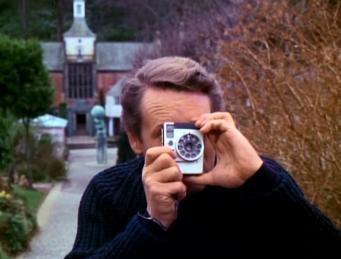
No.6 awakes to find there is no power in the Village and that it is completely deserted. He takes the equivalent of 964 work units from the shop, including a camera and a radio, and leaves on a raft. He is travelling by sea for a minimum of eighteen days when he is stopped by a boat, robbed, and left to drown at sea. He boards the boat and overpowers its occupants, only to find a crate (marked "M12/793") full of handguns. (It has often been questioned whether or not the boat was delivering guns to or from the Village. The occupants are also seen eating village food, though this is almost certainly the food they stole from No.6). Foreigners of an unknown designation, they shoot after No.6 during a struggle, during which he swims towards a nearby lighthouse. He awakes on the coast of England.
There he returns to his home to find it is now leased, along with his Lotus Seven, to a Mrs. Butterworth. She tells him the date is Saturday March 18th. (Which would indeed occur in 1967, and not since 1961 or again until 1972. Thus we must assume that this episode takes place in the year of transmission). We learn that one of her hobbies is cooking, and that she has a late husband, Arthur (the same Arthur mentioned in Dance of the Dead?) who used to serve in the Navy. She also has a maid, Martha. From his house he borrows the Lotus from Mrs. Butterworth and arrives to report the Village to his old colleagues, and discover its destination.
Escape:
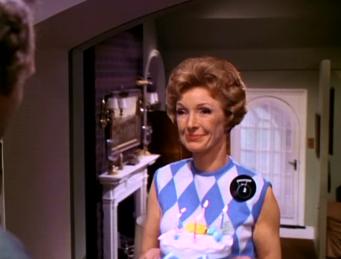
Mrs. Butterworth, if that is indeed her real name, works for the Village, and was setting up No.6, guiding him, along with Thorpe and the Colonel. When he flies back to the Village by plane to assess its location he is ejected and arrives back there. He returns to his Village residence, only for the power to return and everyone to reappear. Mrs. Butterworth greets him with a birthday cake, 19th of March, as we previously learnt in Arrival, indeed being his birthday. The question all this raises is where were the Villagers while they were pulling off this ruse? Underground?
Trivia:
One of just three episodes which don't credit Angelo Muscat as the non-speaking dwarf butler. However, while he is indeed absent from Living In Harmony and The Girl Who Was Death, he does (briefly) appear towards the end of this one, possibly in stock footage.
"Smith. Peter... Smith."
Viewpoint:
I�ve never been a big fan of this episode, largely because if you can�t guess the ending from at least five minutes in there must be something wrong with you. A straightforward escape story with no subtext or allegory, it�s the ultimate dud for repeat screenings.
However, this said, despite such detractions, there�s still a lot to be said for Many Happy Returns. For one thing, any television programme that goes for over twenty minutes without a single line of (English) dialogue spoken has to be commended for being daring. It�s also got some great performances (that pilot aside) and Patrick really getting good at directing in his fifth of six attempts. And with the decision to shoot more footage in Portmerion again (this was the last of the first block to be shot) the production values are high, save for that �No.6 parachuting� sequence.
While I�m not overly keen on the episode for conceptual reasons, the twist ending � as predictable as it may be � is still a killer, well delivered, and there�s no denying that this is a fine piece of television.
