

The fourth series ran from February-April 1985, and was followed by a Christmas Special that same year. Please join me as I rank the fourth series from worst to best...
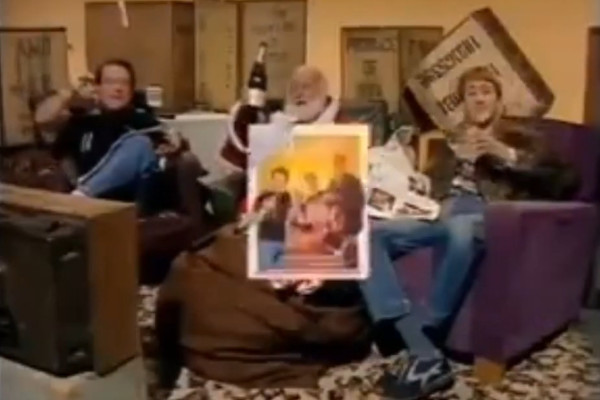
Once again we start an article with a look at a couple of "not really episodes", just for completeness' sake. With ropey screenshots due to their lack of official availability.
This first one is a 1'24m advert for the Christmas Radio Times, which featured the cast on the cover to plug that year's Christmas Special, To Hull and Back. It involves Del, Rodney and Uncle Albert delivering frankly poor lines with no studio audience, making it seem flat and uninvolving. (Sample "gag", when Rodney reads that the BBC are showing Gandhi at Christmas: "There'll be a rush down the takeaways to get the curries in when that one starts." "Ha ha. Even more rushing about after they've eaten it.")
It's pretty witless stuff that doesn't particularly make you want to buy The Radio Times, or watch To Hull and Back for that matter, but thankfully the real thing was much more satisfying.
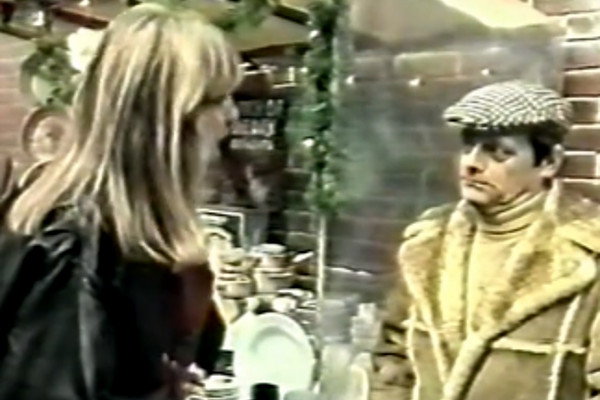
A three minute skit that was shown as part of Breakfast Time on Christmas Eve 1985. Featuring Lynn Faulds Wood playing "herself" (quite badly, it has to be said) as an investigator looking into how Del sold someone white mice claiming they'd turn into horses.
It ties into the panto season with the theme, though is more than a little corny, even ending with a "wah wah" sound effect to wrap the whole thing up. But it's a relatively harmless, forgettable piece.
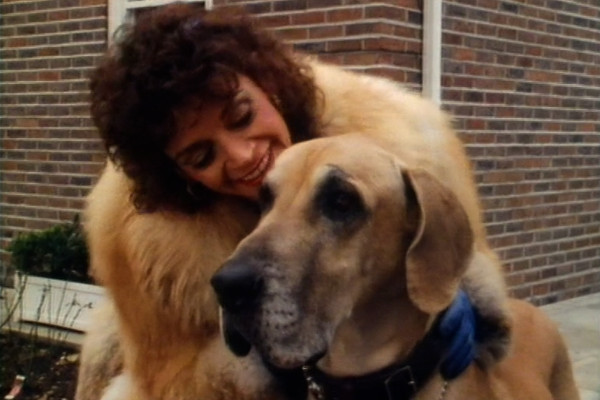
Del and Rodney are tasked with looking after Boycie's dog while he takes his wife Marlene on a holiday. This means that we briefly meet Marlene for the first time, played by Sue Holderness. Although it's a slightly "big" character, she's almost inarguably the most successful of John Sullivan's female characters for the show, and at this point she had been mentioned so many times by Boycie that it's something of a surprise we hadn't seen her before. (Challis' pronunciation of the name "Marlene" one of the most imitatible parts of the show.)
In his 2011 autobiography Being Boycie, John Challis praised Holderness' casting, noting that: "Ray and John with customary canniness had cast Sue Holderness for the part. I hadn't worked with her before, and hadn't even met her, but I knew her reputation for being an original and strong performer. Self-possessed and always a professional, she turned up for her first day's filming in character — brassy and petite, in a pretty good approximation of Marlene's 'style', busty top, short skirt, tons of make-up and rattling with bling."
Challis correctly predicted that Marlene would become more of a fixture in the show going forward, and Boycie also increased his appearances. From series six onwards, Boycie was featured in 21 of the 25 episodes. Marlene, for her part, appeared in 16 of them. In the 2022 Channel 5 talking heads documentary Secrets & Scandals of Only Fools and Horses, the very posh Holderness stated that Marlene was only intended as a one-off character. Sue stated that she got a call from John Sullivan two weeks later after her appearance asking if she'd do more, with Sullivan saying "We weren't going to have Marlene back."
The big difference with the fourth series is, of course, that Lennard Pearce had died of a heart attack during the filming schedule, and they looked for a replacement character. That came with Grandad's "long-lost brother", Albert, played by Buster Merryfield. There's the tendency to think that John Sullivan wasn't sure what to do with the series at the start of this upheaval, but this isn't actually the case. Although the scripts had to be rewritten to accommodate the new character, only the first two episodes of the run were brand new creations... the rest, including this episode, were already written for Grandad.
It's not fair to compare Merryfield directly with Pearce, given that Lennard Pearce had arguably the best timing of the entire cast. But there's the feeling that the ending of this one - they discover that they've accidentally given Albert dog vitamin tablets - would have perhaps had a bit more drive behind it with Grandad. There's certainly audible doubts from the audience as they seem to realise that Merryfield isn't quite, at this stage, a "safe pair of hands", as he notably stumbles over some of his lines in the final scene. In his defence he was probably nervous, being the new guy on the show... of which more in a second...
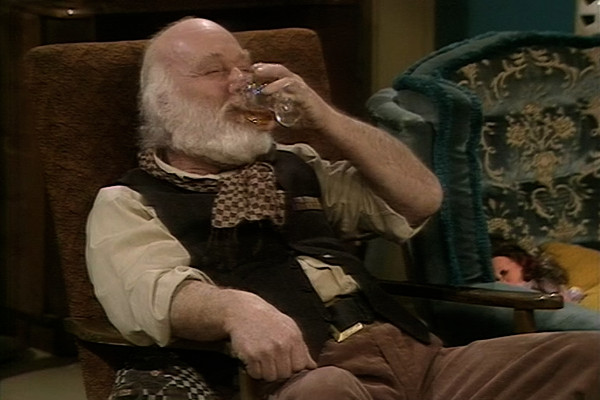
An okayish episode where Rodney decides he wants to be in a pop band for the week. It's a bit left field, and does feel a bit "Citizen Smith" in execution, but It just about gets by. (Not a knock on Citizen Smith, incidentally, which is a fine show, but a very different type of series to OFAH.) Things start to get back into familiar territory when they get into the darker area of what their mother said on her death bed. ("You remember last week we was havin' a row about who's turn it was go down the chippy, yeah? And you claimed that mum said, on her death bed, 'send Rodney for the fish.'")
But the focus of our discussion here is not the two leads. It's not even the fact that one member of Rodney's band is played by Marcus Francis, AKA Graham from '70s kid's show Graham's Gang, recently covered on the site. No, the big story here is 64-year-old Buster Merryfield as Uncle Albert, for he's given something of a bad start in the shooting schedule of the show. This one had location filming (with Merryfield not involved in those scenes) during December '84 and January '85, before the studio scenes were performed before a studio audience on 27th January 1985.
What's significant is that, while always intended to be the fourth episode in the run, it was the second to be shot in the studio, and the first to feature Albert. It seems hardly fair that a studio audience's first introduction to Albert was, chronologically, his third appearance, and he does seem a little nervous, at one point his real RP accent slipping out. Now, of course, it would be a different audience each week, it wouldn't be the same audience, so it's not as if it matters in that respect, but for Merryfield to get relaxed into the part he's not treated well by the shooting schedule.
With this fourth series we have a fourth autobiography to draw on. 1997's During the War and other encounters by Buster Merryfield saw him openly admit his first studio recording had started badly for him, and he forgot his lines and dried: "When we went back on set I was even more nervous than before. I concentrated hard on the job before me, determined there would be no further mistakes. It came as a real shock a few moments later when David Jason got his words in a twist, much to the amusement of the audience. Being the seasoned performer he is, he immediately made capital from his mistake by chiding the audience. "What are you lot laughin' at, then?" he quipped. "You got in for nuffink, dint ya?" He knew how to play an audience and they cheered and whistled. I felt relief that even the greatest of them could fluff his lines and maybe it wasn't such a sin after all. We got back into the scene and everything ran smoothly from then on. It wasn't until well after the show that I realised David had seen how tense I was and had deliberately messed things up to put me at ease. He was that kind of chap."
Yet forgotten lines aside, there's something of a myth surrounding Buster Merryfield's hiring in the series. The popular story is that he was a retired bank manager who wrote in for a part and had no experience, except for amateur dramatics. This simplistic telling of his background is repeated by David Jason in his 2013 autobiography My Life, with Jason stating: "The slightly tricky thing was that Buster had no experience whatsoever of television. During the first recording sessions, in an environment that was completely new to him, he wound himself up more and more with nerves. The pressure on you in front of an audience and cameras is very high and if you've never done it before it can really get to you."
Now, people will tell stories from different perspectives, and many autobiographical quotes shouldn't be taken at face value as they will often be exaggerated showbiz tales there for a laugh, or even the result of faded memories. But Buster's own version of events is that he was called by the BBC, having been known for some small parts.
No matter whose version of events we take as being the closest to the truth, the facts of the matter are backed up with a simple look at Buster's CV. He'd had half a dozen parts in television before OFAH (including two episodes of Shroud for a Nightingale, which ironically also featured Lennard Peace). Despite all this, Jason's popularity and the fact that his autobiography would be more widely read make the exaggerated version of events "the truth". A "truth" that's even been repeated in documentaries about the show.
The reality was that while Buster had some experience of television, he didn't have experience of television with a studio audience. Even a seasoned actor like Timothy Spall got nervous at having to perform in front of one for just a guest role in Red Dwarf. Merryfield does okay, and although his performance can be slightly amateurish in spots, and there is the feeling that he's being somewhat carried by Jason and Lyndhurst, he did improve in later runs.
Let's end on some trivia. First, Albert's hard drinking persona is, much like his accent, put on for the part - Merryfield was teetotal. Secondly, Kenneth MacDonald acted in this episode, despite Mike the barman not appearing. He, Jean Challis and Bob Sinfield all did uncredited voice over work for the "talking" dolls and the rowdy crowd noises heard outside The Shamrock Club.
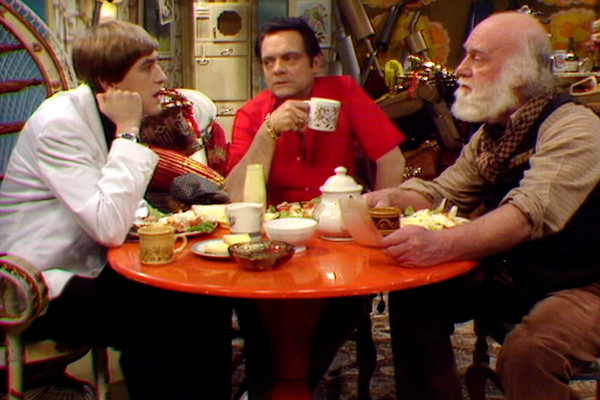
Rodney and Mickey Pearce have a bet that Rodney won't be able to bring a girl to an event at the Nag's Head. It's a vague plot, there just to hang some gags and character pieces on.
There are some coarser bits, such as Uncle Albert talking about his true love ("She never used to charge me as much as the other lads.") and Rodney unwittingly dating a 15-year-old. This latter bit might seem a little shocking today, but times were different and it wasn't the first or last time it would feature in Sullivan's work. The following year Sullivan would launch his fourth sitcom, Dear John.... (1986-1987), that had the lead character at one point mistakenly dating a 17-year-old schoolgirl... and his colleague teasing him that she was 12. Different times.
Talking of different times, then while Del and Rodney's discussion of women isn't always that enlightened by today's standards, with liberal use of the term "dogs", it can be enjoyed as "of its time". But less enjoyable today is a scene where Del cons a barmaid to reach inside his trouser pockets. In 1985 it wasn't that shocking, but times have changed in 40 years, and it seems incredibly seedy.
This is, incidentally, the most edited of the fourth series episodes on DVD releases and streaming. There's a line about Del phoning round old girlfriends for Rodney, and telling Uncle Albert that some of them had died. The line was cut on some repeats, reputedly because David Jason had a real-life partner, Myfanwy Talog, who died in 1995. The line remains removed, at least on ITVX. Also removed is Del's stripper friend Yvonne (Carolyn Allen) singing Billy Joel's "Just The Way You Are" to Del. ("Gordon Bennett, that's my bloody ear 'ole gone!") The sequence is omitted, presumably due to song rights issues, leaving a jarring laughter when Del tells her about Rodney, the audience appearing to laugh for no reason.
One last thing to note is that the episode opens with Uncle Albert playing the piano in the pub. This was an example of John Sullivan finding Buster Merryfield things to do based on his observations of him on set. In During the War and other encounters, Buster wrote: "[John] took a great interest in the show and appeared at most of the rehearsals, picking up vibes and characterisations all the time. I remember once arriving at the rehearsal-room before anybody else and amusing myself on the piano while I was waiting. [...] I was still tinkering away when David Jason walked in. "T didn't know you were a pianist," he remarked. "I'm not," I replied, "I'm just killing time." "Sounds like you're killing the tune at the same time," he joked. I thought no more of it, but he must have mentioned it to John Sullivan who later asked me to play something for him. I gave him a rendering of My Blue Heaven to which he just grunted. However, when I received the script for the next episode, it opened with Albert sat at the piano in the Nag's Head."