
Worst To Best
The Young Ones

The Young Ones was a ground-breaking '80s sitcom featuring the often surreal adventures of students Rick (Rik Mayall), Neil (Nigel Planer), Vyvyan (Adrian Edmondson) and Mike (Christopher Ryan). Playing their landlord and other associated characters was Alexei Sayle. The series is available to buy via Amazon.


by
THE ANORAK
DECEMBER
2025


The Young Ones is a huge favourite here at The Anorak Zone - so much so that this is the third time it's been ranked in an article. It was originally done way, way back in April 2012, then again in October 2019. With the release of the series on a BluRay Collection back in 2022, plus the surprise release of the US pilot, it seemed an ideal time to watch the show again, this time with a range of added extras. This new take on the show contains not only all-new entries and all-new images, but, for anyone that should care, lists how the entries have risen and fallen since last time. Please join me at ranking The Young Ones, from worst to best...

13 Oh No, Not Them (1989)

→ New Entry


Perhaps the strangest post-series project, certainly the least-known, is this American pilot, which sees Nigel Planer reprise his character of Neil for a US adaptation of the show.
     While it was always intended to mention the pilot in this article, what was completely unexpected was the announcement that Nigel was going to stream it on his Patreon Page in November 2025, just as this article was being completed. This was a pilot that hadn't been leaked in 36 years, so was, in many ways, a "holy grail" of TV sitcoms. It's not an "official" or "proper" Young Ones episode, but is worth looking at here.
     The US has produced some decent sitcoms over the years. Yet there's such a prejudice and snobbery towards its culture that most people over in the UK would expect a US version of The Young Ones to involve stripping it of all nuance, "zany cutaways" that treat the audience like they're idiots, bikini-clad "babes" as the next door neighbo(u)rs, a mass gunfight between the main characters where one calls another a "butthead", and an ending where they give each other a hug saying how much they love one another. It's an unfair stereotype.
     Unfortunately... that's exactly what this US version of The Young Ones is. The latter hugging may be an "ironic" take on US sitcom tropes, but you know what they say about Americans and irony. There's no Rick character and no landlord, so it's mainly just Nigel Planer carrying two neutered, directionless fellow student characters, "Rip" and "Todd", one of which is vaguely based on Vyvyan and the other just a stock character of no real discernable invention. Jackie Earle Haley ("Rip") went on to be an Oscar-nominated actor, but he struggles to bring life to the underwritten part.
     The script really makes you realise how special the original show was, and the whole thing is lacking in pace and energy. A real problem with the two new characters is that they have no character motive other than waitiing for Neil to make their dinner for them, and they don't sound dissimilar enough to be distinct. No one would ever mistake the original Vyvyan's voice for another character's.
     A lot of the runtime isn't involved in establishing any kind of premise, but instead indulging in meta humour, repeatedly acknowledging that it's a sitcom. Although the actual series of The Young Ones did this, it built the foundations of the show first. This is like tearing down a house before you've put it up, and, while the idea of deconstructing your own show was far from new, this was going out the same year that "It's Garry Shandling's Show." was on its fourth and final season. Rather than being fresh for the period in which it was being made, the pilot was passé.
     The Young Ones is, at its best, a much more sophisticated series than sometimes credited, but this is made in a country that released the series on DVD under the title "Every Stoopid Episode". It was a cult hit in the US when shown on MTV, but it wasn't exactly received for its subtextual virtues. And as the playing and design of the show is very "Saturday morning kid's TV", what you're left with isn't a show that fits in a 9:30pm schedule, but comes over as something like Saved By The Bell. Being on a network probably didn't help, meaning it has to be sanitised by its very nature.
     The original version of the show has a lot of elements that could, removed from context, be seen as childish. Take, for example, the first episode, Demolition, where two puppet rats discuss classic tragedians before one of them is smashed up with a guitar and the other eats his bloodied corpse. Take away the gore and the references to Hippolytus and Euripides and you're left with... two puppet rats just talking. And that's just one of the scenes we get here... although most of the script by David Mirkin is original material, "based on", rather than remaking, any elements taken from the original show are devoid of deeper meaning.
     Nigel Planer discussed the pilot in his engaging autobiography, Young Once: A Life Less Heavy, where he conceded it didn't quite work, and was a "hybrid" between the US and UK forms. It's hard seeing a genuinely funny character like Neil having to deliver glib Americanisms that sound like they were written by someone who doesn't really "get" the character. So why did Nigel do it? He explained in his book: "I dithered over whether to do it - they wanted me to sign a five-year option before I started, in case the thing was a hit. Normal practice on series in the US. They don't like the idea of you renegotiating your fee once you are indispensable. In the end I agreed, because the thought of someone else doing Neil instead of me was unimaginable."
     So, yeah. It's not great. It's not abysmal, and has the odd chuckle, but it's definitely not great. Yet huge thanks to Nigel for giving people the chance to finally see it. One misconception Nigel wanted to put right in his book was that he'd hated the experience, something largely down to Robert "Kryten" Llewellyn misinterpreting this in his own autobiography, The Man In The Rubber Mask. While Nigel was thankful it didn't go to a series, he was glad he did it, and very much admired the cast and crew, with Robert Bundy ("Todd") described as someone with whom "I formed a lasting friendship".

12 Time (1984)

→ No change


In the previous looks at The Young Ones, Time has always been in the bottom two, and that doesn't change here. Yet, as always, it's worth pointing out that even the least successful episode of the series has plenty of entertaining moments and is well worth a watch in its own right.
     There are some "tits" gags that are beneath the show, and some '80s parodies that date it badly, but really the main issue is the writing. The show has an extremely loose "anything goes" mindset, but even by its normal standards, there's very little payoff or reason behind most of the "zany for zany's sake" events onscreen.
     However, in this fresh look at the series we've got some new products to help us delve into it even further than before. First on that list is the 40th Anniversary BluRay Collection, a superb restoration of not only the episodes, but also lots of extras, and commentary tracks on all twelve episodes. Then there's two autobiographies that came out in 2025: September saw the release of the aformentioned Young Once: A Life Less Heavy by Nigel Planer, then the following month saw the publication of What Have I Done?, the autobiography of Ben Elton. Yes indeed!
     Nigel Planer, Alexei Sayle and co-writer Lise Mayer recorded commentaries on four episodes for the BluRay release: Interesting, Bambi, Cash and Nasty. Like most commentaries, they're often not essential listening for various reasons, but they're very nice to have. The trio spend most of their time getting drawn into the episodes and laughing along, but it's pleasant to hear how much fun Nigel and Alexei have, and their enjoyment at the performances of the cast.
     Despite them not doing a commentary for Time (that falls to producer/director Paul Jackson and production manager Ed Bye), it's brought up here because on Cash Mayer describes the writing process: "We used to all three meet together, and work out what the plot was for a particular episode. And then we'd write two versions, one that Rik [Mayall] and I would have written, one that Ben [Elton] would have written. [...] And then someone, usually me, would sort of weave them together. [...] And then we'd get to the first readthrough and we'd read it and discover it was forty-five, fifty minutes long and then we'd have to cut it. And then we'd have to stay up all night after the first readthrough rewriting it."
     This is the core issue with Time, in that it feels less coherent than some episodes, with signs that it's a few different ideas bolted together at the writing stage. This doesn't mean that it doesn't have some great stuff in it, though. The show tried to make it "as live" as possible to keep the studio audience engaged (screening the pre-recorded moments in sequence) and also genuinely risked the health of the stars. This one has a particular stand out stunt with Rick and Vyvyan falling through the ceiling on a bed. While it's natural to assume it involved some kind of editing trick, not only did they really drop, but it was done before the audience.
     We'll take brief looks at some of the cast and crew autobiographies as we go along, but one that won't be used for any serious Young Ones study is Rik Mayall's 2005 book Bigger Than Hitler, Better Than Christ which, perhaps typically Rik, is written purely for laughs and tells us nothing serious about the making of the show: "So I phoned all the non-entities that I knew, told them I was going to give them their first brake (sic) in showbusiness and that very afternoon, we made the first six episodes of The Young Ones. The following day I was mobbed. Things happened fast in those days."

11 Bambi (1984)

↑ Down 1 Place


Bambi is a much more polished product than most of the first series - faster, more driven, more assured. But it's those things that also make it a step away from what The Young Ones was.
     There are those that praise it - many fans regard it as the episode, Rik Mayall talks about how series two was better made, and even Alexei Sayle, initially disturbed by what he saw as a turn towards the "establishment", concedes that it's now probably his favourite.
     But it's a show that knows it's a success, and revels in itself. Series two largely jettisons the "dead laugh" area, where viewers were treated to variations of almost anti-comedy, and awkward silences made up a proportion of the humour. Here things are forced far nearer to standard feedline-punchline, very much "the American model". Or, "less random than normal" as Lise Mayer describes it on the commentary track. This is no longer "alternative comedy", but just standard reactions, which gives it a mainstream crossover appeal.
     More disappointingly, the series veered away from a realistic world tilted to one side, and into somewhat undergraduate silliness: series one had seen them party with fellow university students and a lecturer who were relatively "real"; series two has them visit "The Fascist Pig Bank", and, here, they appear on University Challenge representing "Scumbag College".
     In What Have I Done? Ben Elton stated that the idea behind the series was brought to him by Rik Mayall, with his stand-up "people's poet" character being a central figure alongside the failed songwriter character of "Neil" from Nigel Planer's stand up. As Ben was always writing scripts, he was given the task of crafting the pilot, and states that Demolition was essentially his script, despite the co-writing credits given to Rik and his then-girlfriend Lise Mayer.
     Ben claimed that he was assured by Rik that this was how the show would continue when it was commissioned for a series, with him writing the scripts alone, and Rik and Lise being "creative script editors". However, Rik changed his mind and, as he was the driving force behind the show getting commissioned, Ben was pushed further away from the central creative process.
     Ben's summary of the writing process for the rest of the series ties in with Mayer's recollections: "I genuinely didn't think it would work if the three of us tried to write the show together and, of course, in the end we didn't. I wrote my stuff and Rik and Lise wrote theirs, and in the main they were the ones who bolted it together. This was a source of real sadness for me, real proper pain. I got marginalized and so lost a very large part of the thing I loved most, busking with Rik and making him laugh."
     Ben conceded that the show was a hit, but that he'd "hated" a lot of the stuff that ended up in the series, and that the only two episodes where he "exercised anything like the control I had over 'Demolition'" were Summer Holiday and this one.
     One difficult element of the show is trying to work out who wrote what. It's generally believed that Lise Mayer was behind the various puppet cutaways, but she rarely reacts to them in commentaries so it's not clear if this is the case at all. (Interesting has her remark "That's... random", but it's not entirely clear whether she's saying it about the puppet plug socket that's on screen as she says it, or it's a delayed reaction to the fact that Vyvyan had just called Mike a "poof".) In promotional interviews for his autobiography, Ben Elton stated that he knew who wrote what bits, but there are only small confirmations in print to give us a fixed idea.
     One thing we can assume from Ben Elton's autobiography is that he had a greater hand in writing Bambi than many of the other episodes, though Lise does confirm that a couple of sequences - the slightly cringy moment where the cast all change into each others' characters, and the "Mary/marry" bit - were her idea. One part Ben specifically cites that he'd written is Rik's "suicide speech".
     Yet just because someone says something, doesn't mean it's entirely true. It's not a question of people lying (though that's possible, of course), but more to do with faded memories and subjective takes. It is, of course, astonishing how memories of events don't always add up to reality, no matter who is involved. Nigel claimed in his autobiography that Ben Elton rewrote the laundromat scene in Bambi during rehearsals as it wasn't working: "But Lise had no memory of Ben ever attending rehearsals, and she had been there throughout. I'm sure Ade would have had a different story again." (Ben Elton spoke to the British Comedy Explained Podcast, where he mentioned rarely attending rehearals, but specified that he did rewrite that scene, so it appears that Lise was mistaken.)
     Then there's Stephen Fry. In The Fry chronicles, his 2010 autobiography, Stephen claims to have suggested the idea behind Bambi to Ben Elton at a drinks night: "Ben may well have a different memory of the genesis of that episode. It is one of the known eternal truths of comic creation that a good idea has a dozen parents while a duff one remains an orphan."

10 Summer
Holiday
(1984)

↓ Up 1 Place


Summer Holiday's a decent last episode, and really only ranks this low down because there's nine other episodes that are better, not for any real failing of its own. The overuse of studio sets (sent up in the episode itself) can pall a little, but there's still plenty of wit and nice dialogue sequences that shows the programme wasn't completely out of ideas when they decided to end things.
     Despite their "deaths" at the end of this episode, the following month Nigel Planer would be second in the charts for three weeks with an in-character cover of "Hole In My Shoe". There was also a pretty good album to go with it, which sadly didn't chart.
     In fact, there was quite an "afterlife" for the group, including tours, and Rik Mayall spoke about how he regarded spin-off book Bachelor Boys as the ostensible third series of the show. (Puerile yet amusing, a margin note takes a playful dig at Planer with: "On the other hand why not find a crappy old hippy number from '67, rip it off for loads of cash and go straight into the charts at number 5".)
     In 1986 they had a No.1 for Comic Relief by covering "Living Doll" with Cliff Richard, in a track that's perhaps not all that easy on the ears. That same year saw the release of a computer game, but by then the repeats had stopped and people moved on to other things. Some of those other projects brought three quarters of the core cast back together, with Planer, Mayall and Edmondson in the okay-ish Filthy Rich & Catflap (1987) and the better Mayall-Edmondson sitcom Bottom (1991-1995), which saw Ryan return as semi-regular character Dave Hedgehog.
     Edmondson and Planer would do an advert in character for Friends Provident in 1989, after Edmondson had done one as an unnamed but clearly Vyyvan-based punk for Natwest during series one and two of The Young Ones. (The postman, Nasty: "Little squirt! He does one advert and he thinks he's Dustin Hoffman.") Then there was a US pilot, featuring only Planer from the original show, which is where we came in.
     Despite being a hit for BBC2, the show still wasn't enormous on first runs. This second series averaged at 2nd place on the BBC2-only chart with 4.59 million viewers... it wasn't until 1985 that repeats would see it break the 6 million barrier. Though such things are only based on "official" figures from BARB... although this particular episode was supposedly 3rd in the BBC2 chart with 4.2 million viewers, it seemed like every schoolchild in the country was watching it.

9 Nasty (1984)

↑ Down 6 Places


The biggest change since last time, how it is possible for an episode that's always been ranked in the top five to drop so far?
     Well, I guess you really have to be in the mood. Series Two is broader and more cartoonish than the first, where the idea that all four of them would be taking turns to get into a bath full of mud isn't realistic in any way. It's funny, sure, but it's not the "recognition comedy" of Rick arguing about the bathroom rota, it's full-on extreme silliness.
     Nasty definitely has plenty of great moments, and a stronger plot than most (if such a thing is desirable) with a framing narrative. But great stretches of it ditch wit, satire and genuine invention in favour of yelling.
     Each episode of The Young Ones got two days in the studio, a rarity for sitcoms. The first day would be to record the more complicated technical moments which couldn't be ideally captured in front of a studio audience. In the case of Nasty, this included things like Rick being attacked by a cutting saw, Alexei Sayle shaving with no reflection, or the entire scene with Stephen Frost and Mark Arden.
     These would be played in to the studio audience the following day, and contained two significant scenes in this instance. Although the BBC didn't keep a lot of behind-the-scenes material for the show, Nasty has 64 minutes of low quality video footage from the first studio day, which can be seen on the BluRay Collection.
     There's a scene with two teddy bears having sex which was deemed too rude by the BBC and cut - though there's speculation it may have been accidentally included on repeats, and it was certainly included on at least one VHS release. (The BluRay, sticking to an accurate presentation of what originally aired, doesn't include it in the episode.) Then there's a scene that was never included or shown anywhere... Vyvyan's hamster, SPG (Special Patrol Group) befriending a curried rat.
     One of the outtakes is notable in that the presence of the studio audience shifts what we're supposed to feel about what's happening on screen. When Vyvyan smashes a window over Neil's head for asking if he's got a video, there's a loud cheer, suggesting that Neil is hated and deserved it... the reality was, the sequence took multiple takes before they got it right, and the cheer is because it was completed successfully.
     Lastly, one of the main discussion points in this article is authorship. This isn't quite as straightforward as it seems, as there are factors such as Mark Arden and Stephen Frost using a lot of their stand-up material in their guest spots, uncredited, whereas Alexei Sayle gets credited for his. Lise Mayer noted that this was also one of the three characters played by Alexei (along with Tommy from Interesting and Brian from Sick) where the parts were largely written for him, rather than purely his own material.
     But another element was also the cast themselves pitching in with ideas, sometimes during rehearsals, sometimes beforehand. In Young Once: A Life Less Heavy, Nigel Planer paints himself as generally affable but having "thin skin", and was known at school as "Tantrum". This led to him having input in this episode: "There's a scene in the second series of The Young Ones that was written at my suggestion. The scene is Neil’s tantrum. Neil finally flips and attacks Rick with a frying pan." In the commentary track, Lise Mayer states "I claim that gag!" in regards Neil using a flower pot to cover himself in the scene. (While we're here, Lise also talks about doing her driving test around the time this one was written, which was where the vampire's highway code obsession comes from.)

8 Cash (1984)

→ No change


There are some voices missing from The Young Ones commentaries. Rik Mayall sadly died in 2014, and Adrian Edmondson and Christopher Ryan declined to take part, or at least their agents did on their behalf. (In his 2023 autobiography Beserker!, Adrian Edmondson explains that he's "incredibly proud of it, and of my part in it", but that it's a show he's spent more time talking about than actually making.) However, there's a small redress of the balance here, as archive audio clips of Rik and Ade, along with Ben Elton, are used for the first 10 minutes of Cash's commentary.
     The remainder of the commentary is Nigel, Alexei and Lise Mayer, and it's here we get a couple more hints of "who wrote what". Not a lot, just a quick "this was my idea" from Mayer when it comes to Ken Bishop's Nice Twelve performing the musical interlude. But there's also a reference to "we" (presumably Lise and Rik, but that's speculation) writing a deleted scene.
     The deleted scene? In 1984 editor Ed Wooden had put together a little highlights/goofs package for the series two wrap party, calling it Just For Fun. It wasn't intended to be broadcast, but can now be seen as an extra on the impressive BluRay Collection. What's significant is that the unused scene is included in it.
     21 minutes into the episode there's a really jarring edit where Neil is thrown onto the street from the Army Careers Information Office ("Don't tell them you're a pacifist!") before being picked up by the others. Suddenly they're standing in different poses, with clearly something cut out. What that "something" was, was Rick saying "You complete wanker, Neil", before being asked to repeat it. When he does so, Neil turns to the camera with a: "That's what I thought you said. I didn't know you were allowed to say 'wanker' on television." (On the commentary Mayer claims that this then segued into the even more explicit: "No, you can't say 'stop f***ing that dead dog up the ass and eat my shit, Mrs. Thatcher'", but this isn't included. Mayer does specify that this was to be bleeped, and was more just to make the production laugh rather than a serious part of the script.)
     There's also 41 minutes of low quality studio footage that exists for Cash, which again appears on the BluRay collection as an extra. The studio footage gives some idea of how painstaking some of the shots are, as well as letting you in on what bits were recorded without the studio audience. There are times when the technical set ups are so exacting it makes you wonder how they managed to create the illusion of manic spontaneity... you also get to see Rik Mayall slide down the stairs and hit his crotch on a bannister four times in a row. Although the elements of the stair rail are props, there's surprisingly little artifice involved, as Rik really does bash his groin in the name of art.
     Cash could have ranked a place or two higher up in this list, as not only is it frequently amusing, the cutaways are some of the strongest they ran with. Vyvyan saying he's pregnant is one of the sillier plotlines, even for a show like this, but was suitably hilarious when it was watched as a schoolboy. Although it's not discussed who wrote it, Mayer reveals that the "Vyvyan pregnant" bit and its resolution was: "[...] based on something that really happened to Ade when he got rushed to hospital thinking he was having... had a ruptured appendix or something. And the doctor put his finger up his bottom and a ten minute fart came out."
     Alexei Sayle's involvement in the show often produces different reactions, from those who don't really find him all that funny, or think he disrupts the narrative too much, to those who enjoy his input. On the commentary track to this one, Alexei turns into one of his own biggest critics at the start of the "stupid noises" song sequence, which comes towards the end of an unusually long, 3'20m sustained appearance from Sayle.
     "I'm in this a lot, aren't I? [...] God, this is... errr... you see why... you see why some people hate me. [...] I thought that I could be as big as, you know... Billy Connolly or something (laughs) doing stuff like this. I could be at the very top of... the hierarchy of light entertainment. I could be a popular family f***ing entertainer.... doing THAT."
     Ben Elton doesn't reference Sayle much within the context of The Young Ones, but does note he struggled with writing him in the first episode: "Maybe it was Rik and Lise's idea. All I know is it certainly wasn't mine. [...] it was a weirdly inorganic bolt-on to the purity of the original (already multi-layered) idea". For what it's worth, while Sayle's input can be hit and miss today, as a child he had me in hysterics, and that's really all that matters.
     Lastly, one slightly perplexing thing about this episode is that the usual set up of the house is different, with the fourth wall changed. Suddenly we're seeing everything through the perspective of what would normally be the front window, so that what would be the regular fourth wall can now been shown to contain a plot-necessitated fireplace. It's hard to work it out at first, but the angle from other episodes does show it's the same dimensions. What creates a form of optical illusion (it seems much narrower than usual) is the spatial awareness that the wall wouldn't normally be there, and instead contain the studio edge leading to the audience.

7 Interesting (1982)

→ No change


The Young Ones does a comedy of manners as the group organise a house party for various different guests. It's an important instalment, because it shows how four such disparate characters could possibly live together in the first place. While the arguing still takes place, there are moments where even Rick and Vyvyan have amiable conversations, as all direct their energies towards trying to impress their highly unimpressed guests.
     This was the first episode to reach the BBC2 Top 10, making joint sixth place along with an edition of Russell Harty. Both got 3.55 million viewers, while the following week The Young Ones made sixth place in the BBC2-only chart by itself, with 3.3 million. The ratings began to increase during a 1983 repeat screening (though still only half of them made the BBC2 Top 10), and picked up further for the second series in 1984. The commercial peak of the show was probably a 1985 repeat screening of all twelve episodes.
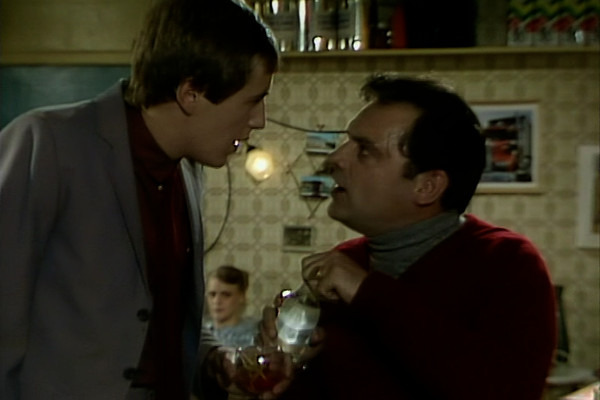
     Time moves quickly, and when this series was last covered in 2019, a fairly new breaking discussion was the revelation that there's an unreferenced "fifth housemate" in the show, a long-haired character that is unnoticed, despite appearing in plain sight. This has now been widely covered, and, although there's still more to learn about it, it's far more widespread than it was six years ago.
     It's still a fascinating element of the show, though. The character in question is pictured at the left-hand side of the screen above. Paul Jackson discusses it on the commentary to Flood, noting that it might be the only episode not to feature her, and, yes, identifying that she was female. Jackson talking about "they" (ie. other people not him) had the idea to include her, as probably a guest at a party that never left. (Though this doesn't explain how she appeared in both houses, as she was also prominently in Demolition.)
     So, who devised the fifth housemate?. Paul Jackson says it wasn't him, and Ben Elton, when asked, had no idea about it. Lise Mayer also talks about the vague "backstory" of the character, so was probably involved. Whatever the full facts behind this eerily silent character, it suggests fascinating things about the very nature of perception, and how things can be, as the saying goes, hidden in plain sight.

1 Next