

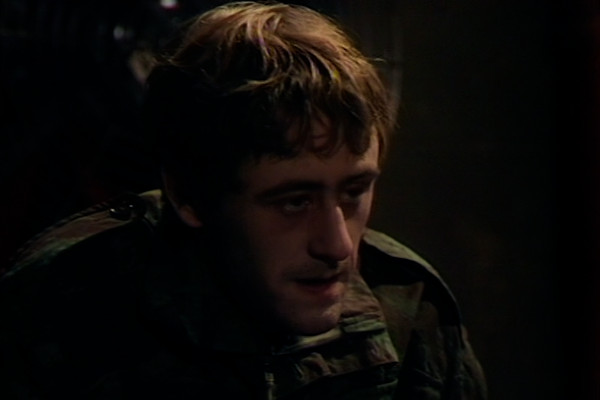
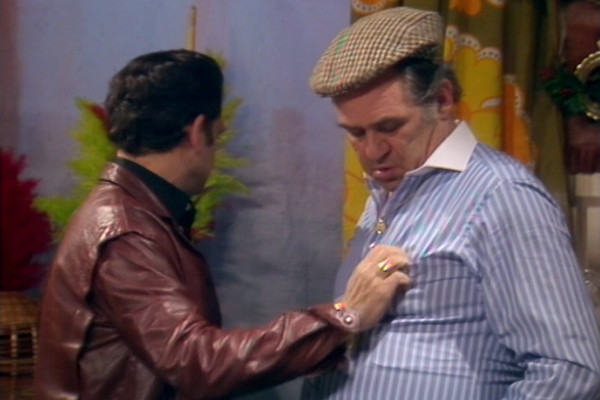
Rodney is accused of trying to sexually assault Blossom, a mentally unstable woman who makes such claims regularly. When Del hears about it, he tries to wind Rodney up, causing Rodney to go on the run.
Something of an odd mix between an old fashioned sitcom and something much more unsettling for the timeslot. Of course, the subject of sexual assault - even the word "rape" being used three times - wasn't particularly shocking at the time. As bizarre as it may seem today, such things weren't that out of place for TV of the '70s and early '80s, with even family-friendly quiz shows like 3-2-1 not averse to having a rape gag in it.
We won't go into whether such things are right or wrong, but merely acknowledge that we're going back into the archives to watch a piece of television that's almost 43 years old... and things were different then. That's how things were.
But the perhaps quite revolutionary part of the script is that - spoiler - Rodney's weed smoking forms a direct part of the plot. While it would later be mentioned, or his suspended sentence sometimes used in plots, this is the only real time it directly drives a plot. Del manages to sniff him out as he's been hiding in the air vent room of the tower block.
When people discuss weed smokers on TV, OFAH rarely comes up. Of course, Neil from The Young Ones had explicitly smoked cannabis over a year before this episode aired, but that was post-watershed BBC2, and most of the many modern TV shows that feature it are similarly after the threshold. But this was an 8:30pm, mainstream family audience slot for BBC1. Although there are increasing signs the show is veering more towards MOR, this element alone makes it remain the edgier, left-field show it began as.
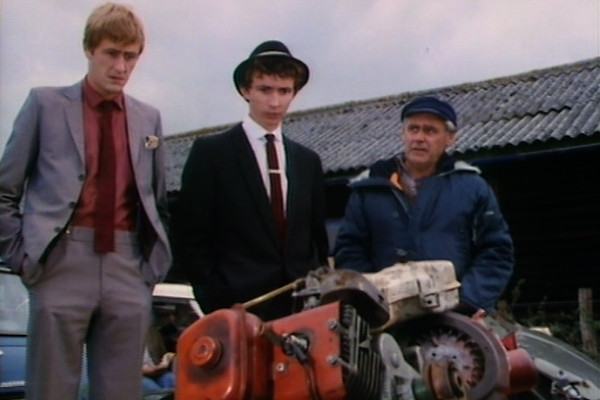
Rodney decides to separate from Del and go into business with his friend Mickey Pearce.
This is a more than decent episode, but does give nods towards how MOR the show will get in the future - Del can't run down an alleyway without stray dogs deciding to chase him. But most significant is that the episode contains the first onscreen appearance of Mickey Pearce after being mentioned three times before. (If you're counting, in Go West Young Man, Christmas Crackers and No Greater Love). Played by Patrick Murray, who was then most known for Scum, he returned in Wanted, and had three more appearances from 1985-1986 before becoming a full blown regular in series six.
A "spiv" character, decently played, but the narrow definition of the character (he dresses like a two-tone spiv in a trilby, basically) meant he didn't really change and was still wearing the same get up as a man in his mid-40s by the time the series ended. But all that's still to come. He makes a decent enough impression here, and makes a difference in the dynamic by being one of the "gang" who's a friend of Rodney's, rather than Del's.
However, perhaps the most discussed element of this one is Rodney saying he's putting £200 into a business investment, only for Lennard Pearce to ask if he's got a wendy house. In My Life, David Jason recalled: "It's hard, even now, to summon words that adequately account for the volume of the laughter this line got from the studio audience. The laugh went on so long, it threatened to run into the next episode - and all Nick and I could do was stand there and ride it, while trying not to join in. When we had completed the filming, I stepped forward to say a few words of thanks to the audience, which I always liked to do. This time, just to tease Lennard, I said, 'That's it. I'm resigning. Nick Lyndhurst and myself have worked our socks off all evening for this show. Lennard Pearce hasn't said a bloody word - and then he just says "Wendy house" and he gets the biggest laugh I've ever heard in my life.'"
As with many showbiz autobiographies, the details can get lost to time, as Del does laugh at the remark, so he didn't have to keep a straight face after all - though there's obvious editing going on to trim it down.
Out of the third series, then this is the only edition where the BARB ratings aren't currently available. (The BBC archive site lists it as being watched by 9.7 million.) However the other six regular episodes showed the series was finally starting to catch on with the public in a bigger way, with an average of 10.55 million viewers and 6th place in the BBC1-only chart.
Let's end on a bit more trivia.... The newspapers the characters read are perhaps not what you'd expect. Although Del reading The Financial Times fits in with his big plans, he can often be seen reading The Daily Mirror... whereas politically active former art student Rodney says in this one that he had a subscription to The Sun.
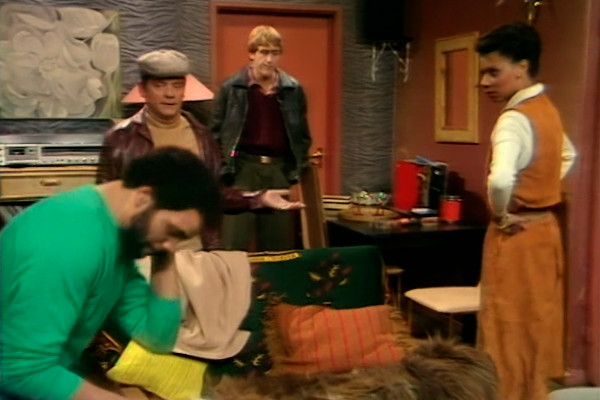
The Trotters get a job redecorating the flat of their friend Denzil, only to find his wife's canary has died while they've been working.
This is a shaggy dog (or canary) story, but it has a pace and energy that makes it work. It also introduces several new characters, three of which could have grown to be semi-regulars: Denzil, Corrine and Mike. Denzil (Paul Barber) is a henpecked husband, while the real find here is Eva Mottley as his wife Corrine. A no-nonsense woman with a grudge against Del, her chemistry with David Jason is off the scale as he fears for his life around her.
Mike Fisher was brought in as a regular landlord for the Nag's Head pub, though actor Kenneth MacDonald probably had more to do (and did it better) as Gunner Clark in It Ain't 'Alf Hot Mum (1974-1981). Mike would return for another 29 episodes, while Denzil would come back another 17 times (plus an appearance in spin-off The Green Green Grass in 2005.)
Sadly, actress Eva Mottley, playing Corrine, took an overdose in February 1985. John Sullivan reputedly didn't bring the character back out of respect for the actress, and what could have been a classic OFAH character instead became a single episode appearance. Later Denzil appearances would see him refer to Corrine as an off-screen presence, before eventually saying she'd left him.
Also making his sole appearance is David Jackson (AKA Gan from Blake's 7) as Irish painter and decorator Brendan O'Shaughnessy. He actually does a fine job, and it's a shame he wasn't brought back. The character is mentioned again, but not seen.
While there's a lot to praise with this one, there can be an overload of racial characterising which makes it seem a little corny when watched today. Brendan is a somewhat stereotyped character, Denzil perhaps never becomes fully three-dimensional, and even the pet shop owner is a broadly-drawn Italian.
Perhaps the worst bit of this is the start of the episode, where Del goes up to a Sikh guy in the pub and tells him that his wife has got "a terrible spot on her forehead". A lot of OFAH fans will repeat the mantra: "Back in the old days when we could laugh at everything, before the woke brigade destroyed comedy", but it just doesn't add up. Why would a Sikh man have a wife with a bindi? It's just cringy stuff, dated in a bad way, and takes down what is a pretty funny episode.
However, in terms of ratings, then with this episode the show finally cracked it. With 11.8 million viewers, it was 4th in the BBC-only chart, and managed joint 10th in the national chart, tying with an episode of Crossroads. (Although frequently slated, Crossroads was popular with viewers.) It was the first time the show had made the National Top 10 chart, something hard to believe considering how massive the show went on to become.
Paul Barber released his autobiography, Foster Kid: A Liverpudlian Childhood in 2007. The story of his tough upbringing in foster care, it only briefly touches on his work in Only Fools and Horses, so we won't get a lot of insight, but we will get some tales about it.
One tale Barber writes about is not getting into the RSC, believing it due to his accent: "But my Scouse accent did prove lucky when I auditioned for Only Fools and Horses. As soon as Ray Butt (director and producer) heard me speak he decided that I was the man to play Denzil. I had great fun doing this series."
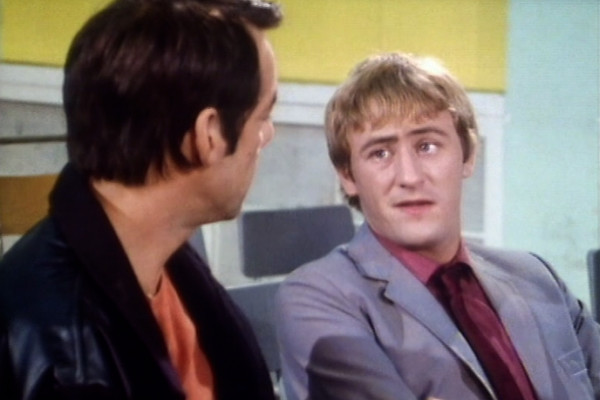
Rodney gets a job as chairman of the local council's planning committee, which ties in nicely with Del's plan to move the family to a council bungalow.
The plot to this one is brilliantly warped, with Del's Machiavellian antics upped to their highest levels, and all kinds of emotional manipulation involved. The curious part is working out exactly how far Del's scheme extended... did it even go back to Trigger psychologically manipulating Rodney into standing for the council in the first place?
Speaking of Trigger, then this one is an essential episode in that it finally fixes a joke that wasn't working. Trigger calling Rodney "Dave" was a guaranteed laugh-getter throughout the show's history, and even though you knew what was coming, it rarely felt flogged to death because Roger Lloyd-Pack was so good at delivering it.
Yet surprisingly, looking back, for the first two series it didn't get a single laugh from the studio audience. Part of it was unfamiliarity with the characters, but also just trying to establish why Trigger was calling him Dave. Here it's met head on, with Rodney finally cracking and asking: "Trig, why'd you call me Dave? My name's not Dave. My name's Rodney."
The entire sequence gets laughs from the audience - "So what's Dave, a nickname, like?" - and the show didn't look back as far as this particular gag went. Note, incidentally, how Trigger does call him Rodney when nominating him for the council, suggesting that he's less "stupid", more of a wind-up merchant. The character's later degeneration into "comedy idiot" sadly removed any blurred lines.
A Christmas Special that sees Del and Rodney's long-deserted father return for a visit. Reg (Peter Woodthorpe) attracts sympathy from Rodney and Grandad, though proves to be an irredeemable character and never returned to the show.
It's a strong episode, with raw emotion. Woodthorpe was only 8 years older than David Jason in real life, but the character of Del Boy was, at least at this stage, around 5-6 years younger than Jason, placing the gap a little wider.
As the years went on, the show did, perhaps naturally, begin to contradict itself, as if writer John Sullivan forgot minor details. In series six we're given the information over a couple of episodes that Rodney's birth date is 2nd November 1962. Here we're told that their dad left in 1965 when Rodney was 5... meaning his birth year must have been 1960/1961. Of course, such things are issues with the later episode, which retcons that birth year, as Rodney's age (and his age in relation to Del) gets put on a form of "sliding scale" so he never gets too old in the show.
But talking of Rodney and continuity, here he argues with Del that he'd like to get to know his father as he doesn't know what he's like. ("Yes you do, I've told you often enough.") Exactly ten years later Rodney would claim to have vivid memories of his father and domestic violence between his dad and Del in the 1993 Christmas Special Fatal Extraction. While it's possible that Rodney had a form of "suggested memory" from hearing Del slating his dad and having his view of his dad shattered, it does go to show that the continuity of the series began to get askew the longer the show went on.
The 1993 Christmas Special was when the series was at its commercial peak, being second in the charts with 19.59 million viewers. Although this third series saw the show finally start to get popular, it was still a long way off those numbers, having to settle for an audience of 10.75 million. It was 6th in the BBC1-only chart, but as BARB were only publishing Top 10s per Channel at this stage, and ITV was generally beating the BBC quite handily in the ratings, there's no way of knowing the overall position. (Though as the 10th-rated ITV show that week had 11 million viewers, there's a very reasonable chance it made the national Top 20.)
Repeats of this episode saw the following lines edited out, presumably due to respect after Lennard Pearce's death, with Del claiming "In all that time he didn't know if Grandad was dead or alive" and Rodney replying "Well we're never that sure". At least some of the DVD releases of the series have contained this edit, these removed lines not restored for commercial release.
On the subject of trivia, then this is the first time that someone other than Del has said "plonker", with Rodney using the phrase. If you're keeping track, then this means that at this stage we've heard 17 "plonkers" throughout the entire run to this point... but only 16 of them were said by David Jason.