

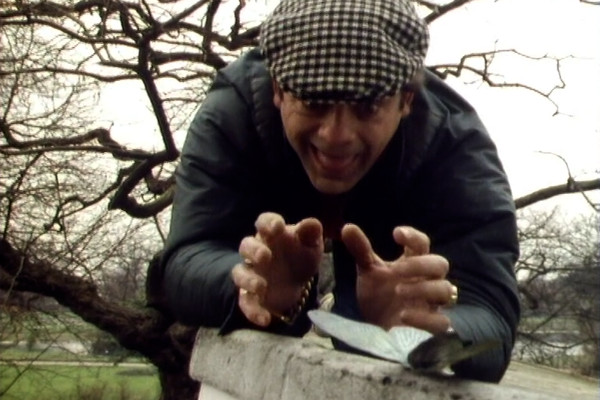
With money tight, Del urges Denzil to give him his redundancy money to fund a dodgy deal... and when that doesn't work out, Rodney comes up with a plan to capture a rare butterfly worth £3000.
This last episode in the fourth series was the highest-charting – albeit not the highest rated – reaching 3rd place in the national chart. While the third series had seen the show become a hit for the BBC, this fourth run built on its growing popularity, with its average audience of 14.48 million a 4 million increase. (This particular episode was watched by 14.17m).
This one definitely has its moments, but, like a lot of the fourth series, it's a little "MOR". Like Sleeping Dogs Lie, it's a show that would have fitted the original
Ronnie Hazlehurst theme, its Granville-style high jinks of butterfly chasing more akin to a blue rinse-pleasing end-of-the-pier show than what was once a socio-political comedy drama.
The only regular episode from the fourth series to feature Paul Barber as Denzil, in his 2007 autobiography Foster Kid: A Liverpudlian Childhood he revealed that he was involved in the ending: "In the original script I was supposed to be walking past Del with a ghetto blaster over my shoulder and then slap hands. Thinking about it in the pub, I told Ray that I thought it would be better on roller skates, so that by the time Del looked up from the squashed butterfly in his hand I would be well out of sight. Ray sent me off to the props rooms. Soon after, the weather got worse and as a consequence I had to practise roller-skating in the snow for two weeks before we got round to reshooting the scene. It worked like a dream and I felt so proud."
Let's end on trivia, and the all-important Plonker count. It's said four times in this edition, once by Rodney. Rodney also says it in the Christmas Radio Times advert, but if we disregard that as not quite official, we arrive at a total of 24 by Del, 2 by Rodney as series four draws to a close. Add the Christmas Special, To Hull and Back, and we're up tot 26 "plonkers" from Del.
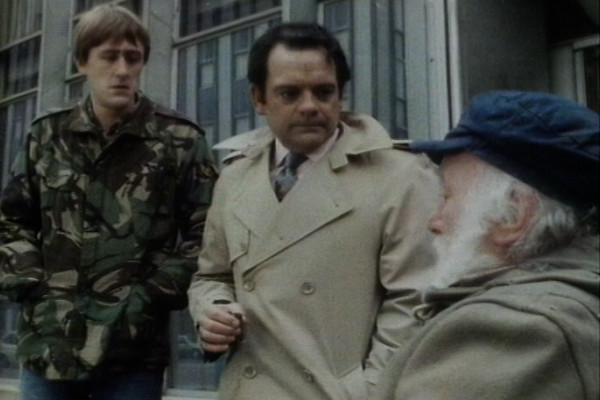
The Trotters are once more down on their luck, when Uncle Albert falls down a beer cellar in the Nag's Head, and they go to court for compensation.
This one is a hugely significant episode in the run of the show. As is fairly well-known, Lennard Pearce had been involved in the location filming for this episode, and had recorded material before he had a heart attack on 12th December 1984. Filming was put on hold to give him time to recover, but he had a second heart attack three days later and died. As of 2026, this footage still hasn't been found, with it being generally believed it was wiped out of respect for Pearce's family. (I always thought it'd be more respectful to keep his final recorded work, but what do I know?)
David Jason's autobiography can be the product of hazy memories, as he claims filming started in February 1984, which clearly wasn't the case. But what was real was that they had recorded material for this edition with Lennard Pearce, and had to go through the emotional pain of recording those same scenes again with Buster Merryfield as his replacement.
Although the scripts were adapted, there's still some inconsistencies brought up as a result. It's revealed that Albert hardly left the Isle of Wight during the war, which can be explained away, but not by "it was written for Grandad": it went out in the show, so it's canon for Albert. One thing that does work better is that it's more believable that Albert could deliberately fall without injuring himself, as we learn it's a trick just raise money. Although Merryfield could be inexperienced in these early editions, he does manage to make things touching when he says he did it all for Grandad's grave.
Back with the first series we touched on the use of racial slurs in the show, with the term "p***" being said in The Russians are Coming. This term is most used in this fourth series, being said 4 times, plus another in the Christmas Special. After this, it seemed to be dropped from the show, save for a rapid "Did he really say that?" use in the series seven episode He Ain't Heavy, He's My Uncle. (This last one came so late in the run that I wasn't expecting it... if you read the series one article when it came out you may notice it's been updated slightly in this regard.)
So altogether the term is used 7 times throughout the entire run of the programme, and the most times here, with Albert saying it 3 times in this single episode. There's no shock or reaction from the audience, as if it's just a regular term... did people really use to say that so casually way back then? I lived through those times, but my memory of it isn't that prominent.
One last point to note is that the opening titles are updated here, with new pics of David Jason and Nicholas Lyndhurst to go with the shots of Buster Merryfield. The previous two episodes had used the ones from 1981, but just with Jason and Lyndhurst alone, the credits to Strained Relations sensibly not spoiling the reveal that Uncle Albert would stay on as a regular.
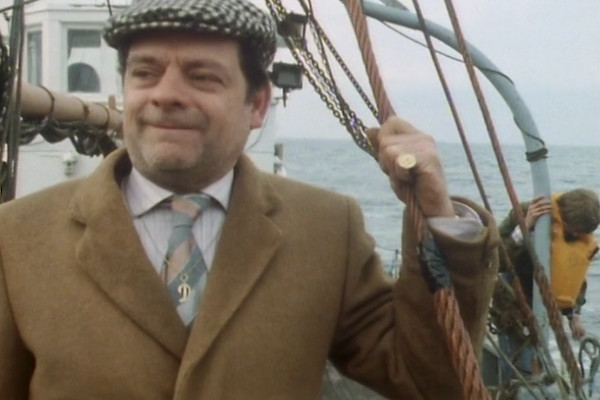
A Christmas special that was 4th in charts with 16.92 million viewers. By this stage the show was a regular part of the BBC's repeats, and this special immediately followed a six week rerun of series four. (It's Only Rock And Roll, not included in the repeats, wasn't reshown until 1991.)
One thing to be commended here is the scale and ambition. Rather than just doing another studio-bound Christmas episode, they made a feature-length movie all on film, in foreign locations, and without an audience. This last part does take some getting used to, as the arguing amongst the group does seem more savage without laughter to tone it down.
In many ways it's like OFAH from a parallel universe, where things are a bit more tragic. Involved in a diamond smuggling plot, Boycie shows his true colours by trying to shop Del to the police at the end of it. Boycie's not alone in this, as he has a colleague that is known to Del, but whom we've never seen in the show before: Abdul.
In his second autobiography, 2012's Boycie & Beyond, John Challis described the actor playing "Abdul", Tony Anholt, as undergoing personal issues at home, and he also wasn't too keen on having his skin darkened for the role: "[...] Tony wasn't too happy about being darkened up for his part as Abdul, apparently anxious not to look too ethnic, although I tried to help by suggesting to him that this only heightened his appeal. I also had the impression that he thought the whole 'sitcom' thing was rather beneath an actor of his provenance. He considered himself a serious actor and wanted this acknowledged, which he encouraged by picking holes in John Sullivan's wonderfully crafted scripts, and sighing in a supercilious way at some of the more overtly comic moments, which unsubtle as they may have been, were viscerally funny. For all that, he was a perfect foil for Boycie's more extravagant persona, and I was sorry that he never featured in the series again."
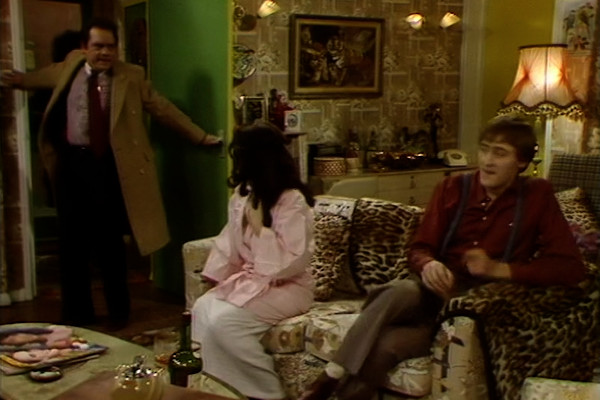
Del bumps into another ex-fiancée, and believes he could be the father of her daughter... the same daughter Rodney is dating.
The episode was the first one shot in the studio, going before an audience on 20th January after exteriors were filmed in December/January. This edition was one of two written for the run after Lennard Pearce's death. Rather than opening the series with a downbeat episode, they begin something more farce-like, though the in-universe story is that Grandad is in hospital. He's mentioned several times in the episode, something that must have been hard when the people involved in making it knew he'd already died.
As John Sullivan couldn't be realistically expected to keep a full backstory on all the characters, what with working on other projects as well, then this is the part of the show where things to start to drift, continuity-wise. Naturally, some hardcore OFAH fans can get quite irate when this is mentioned, but notable here is Rodney saying that he's 24 years old... despite the fact that he was 23 in Big Brother, and there's been three Christmas episodes since then.
As one last piece of trivia, then two weeks before the start of this new series, Nicholas Lyndhurst had appeared for the second and last time as a panellist on Blankety Blank. While David Jason had been able to make more of an impact in six pre-OFAH appearances on the quiz with Terry Wogan, Lyndhurst's naturally shyer, more reserved personality and Les Dawson's more dominant hosting style meant he wasn't as much to the forefront of the show. Plus, it's easy to forget that at this point he was still just 23. In real life, at least.
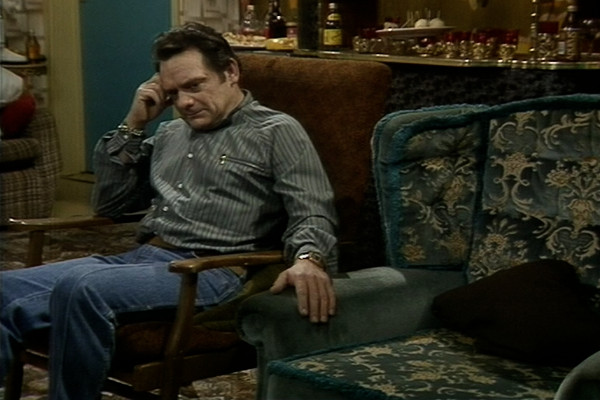
There could be little doubt, really, could there? Arguably OFAH's finest episode as the real-life passing of Lennard Pearce is worked into an episode where the characters all come to terms with Grandad's death.
The show got increasingly broad as it went on, to the extent that episodes in the '90s depicted Del almost as a buffoon, with "no one is that stupid" dialogue. But here Jason is still in control, channelling his personal grief and revealing just how much of "Del Boy" is just a façade: "I've always had to play the tough guy. I didn't want to, but I had to. And I've played it for so long now... I don't know how to be anything else. I don't even know how to..."
Despite the episode's brilliance, there is something of a myth built up around the uniqueness of the content, mainly from sources that like to talk up OFAH as being a truly ground-breaking show. That's the idea of how unique it was to have an episode based around the real life death of a performer.
In UK terms it's not too far off, to be fair, but US TV had predated it on several occasions. And while having a person's death as the core theme of an episode was new for UK TV, episodes like Steptoe and Son's A Death In The Family based an entire episode around death, even if it was just the death of a fictional horse. So no, it's not that groundbreaking. At least not as much as people like to claim. But it is a very good sitcom episode.