

With Channel 5 resurrecting Play For Today last month (which we will be looking at), it seemed an ideal time to look back at the original classic version of the show. Please join me as I rank the fifth series from worst to best...
What makes the fifth series a good place to start with Play For Today is that it's the first one that's - nearly - complete. Series one-four, collectively 91 episodes, saw the BBC junk 30 of them, over 30% of it no longer existing in the archives*. We can look at these earlier runs in the future, if you'd be interested in articles on them, but for now, starting with a run that's virtually complete seems an easier starting point.
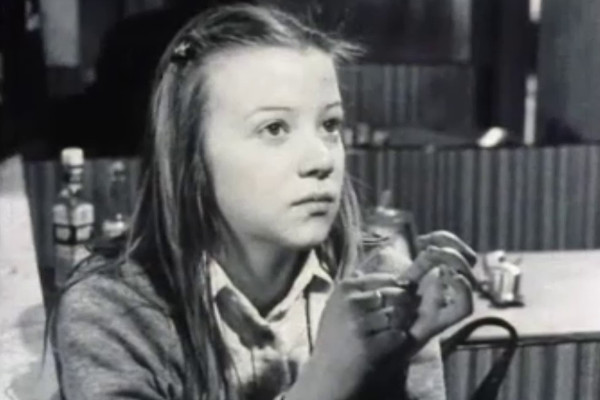
So, Dandelion Clock. Despite airing relatively late (May 1975), it was junked by the BBC and, therefore, has to be placed last by default. It might be a classic work of television, it might be dreadful... we simply don't know. Journalist Leonard Buckley wrote in The Times of the "convincing portrayals" of the inexperienced child performers in the main roles, and the "searing dialogue", but we have no actual footage to go on here. The image above is taken from another episode, as they featured stills of other editions in the opening title sequences. However, these stills were either tinted, or, more often, shown in black and white. The actual episode was in colour.
The play was a look at "The Troubles" from the perspective of a young schoolgirl, and was originally planned to be shot in the streets of Belfast. Despite the situation still being very real at the time it was made, the paramilitary chiefs of both sides of the political divide were contacted and agreed to support the filming of the project and the safety of the cast, no matter what their background. Sadly, the BBC got cold feet and it was eventually filmed in the BBC's London studios.
* Although the BBC junked 30 episodes, two editions from the first series - The Write-Off and Reddick - were Canadian Productions that were shown as part of Play For Today to bump up the number of episodes. Although they no longer exist with the 'Play For Today' title sequences, they DO still exist in Canadian television archives, hence the "30%".
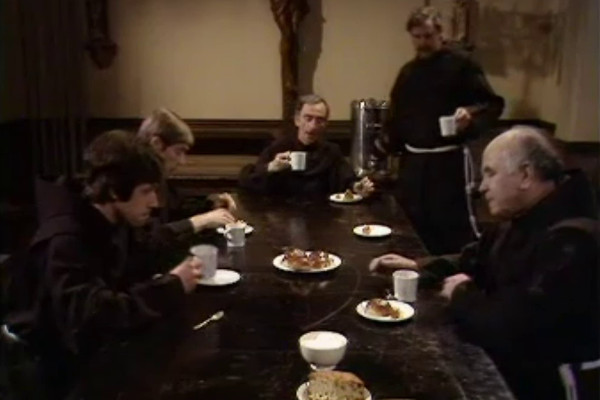
The "Fugitive" in question is a friar who contemplates going on the run from his Dublin monastery to elope with an unmarried partner. Writer Sean Walsh gives insight into the workings of a religious order, and it's all very competently put together and acted. Yet it maybe lacks dramatic intent to pull the viewer along, at least until the final third.
Play For Today often had an "Earthy" quality to go in with its middle class sensibilities, and quite often you'll hear frivolous references to sexual assault, or witness nudity that doesn't necessarily drive the plot. You get both here, as star Stephen Rea ends the play with his willy out, making a joke about a woman who needed plastic surgery to get the smile off her face after being sexually assaulted "28 times" by a "mad black man".
It was the 1970s.
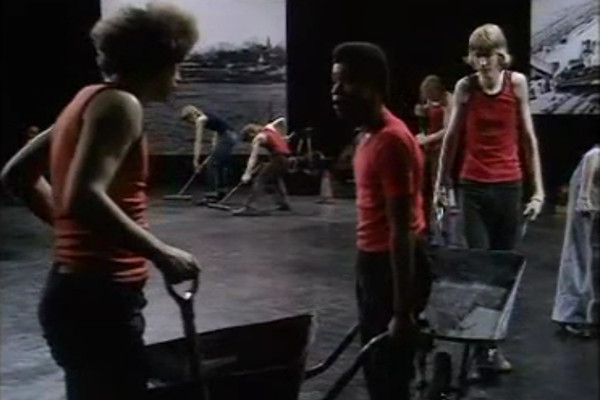
Play For Today usually had at least one "experimental" play per series, which went against traditional television conventions and was a bit more "arty". This could have been things like... I dunno... the nude wrestling scene in Women In Love recreated by spiders. Puccini's Tosca being delivered solely in mime, performed by Jim Bowen covered in pipe cleaners. That sort of thing.
"By Common Consent" is "that sort of thing". Well, almost. It's not arachnid erotica or Bullseye-orientated opera, but it's a stage play performed as a stage play on television. Not only that, but it's performed by the National Youth Theatre, meaning some of them may not have gone on to "make it".
Of this bunch, then you've got Deborah Farrington and Adrian Mills, plus the bloke who went on to direct the 1996 Doctor Who TV movie. There are also several of the troupe who had regular careers on television, even if they never became household names, such as Michelle Abrahams and Andrew Dunn. But of the 47 credited people in this large cast, it's believed that 28 of them had this as their sole acting credit, at least as far as film and television is concerned. It really is a tough business.
There are plenty of darker moments: along with Child Of Hope and Gangsters, this is one of three Series Five episodes to feature torture via electrodes. It's also earnestly political in places, and the whole stage is overseen by musicians, who will get the guitars out for some song sequences.
"By Common Consent" (the quotation marks are part of the onscreen title, so included here for full accuracy) doesn't have the opening Play For Today titles, at least on the copy I saw, so is it actually a Play For Today? Well, yeah, it is. It wasn't advertised as such in The Radio Times, and, as stated, doesn't have the usual titles. It was also the last of the run, so could potentially be just a play after the run had finished. But production boards see it listed as "P.F.T", and shots from the play are included in the opening montages of every episode from Child Of Hope onwards (including, presumably, Dandelion Clock).
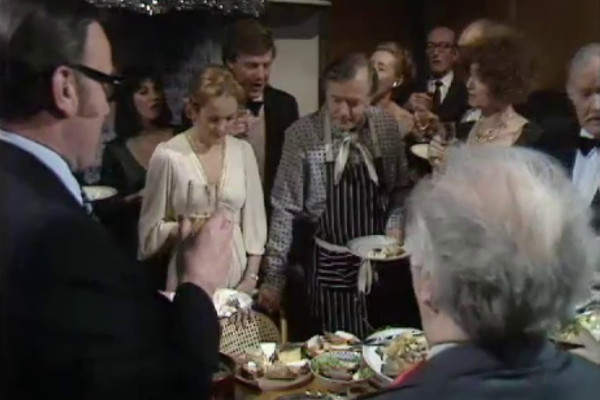
The Saturday Party centres around Richard Elkinson (Peter Barkworth), a somewhat wealthy stockbroker in a loveless marriage with his wife Jane (Sheila Gish). Each year they host an annual Christmas Party for multiple guests and their children, only this time Richard has been told he's being made redundant. As the prospect of selling the house overshadows the party, a variety of tensions rise to the surface.
While ostensibly one-off dramas, some of the editions of Play For Today did have sequels within the show itself. Series Two gave viewers The Fishing Party, a tale of three miners - one played by Brian Glover - that received two follow-up plays with the characters. More meta was Series Three, which contained Only Make Believe, a Dennis Potter play about a writer... who happens to be writing the Series One episode Angels Are So Few.
This brings us back to The Saturday Party, which got a sequel during Series Seven, 1977's The Country Party. The sequel was arguably more successful, and would have ranked much higher if it was part of this run. This is not to say that this first play is bad. All concerned play their parts very well, and Barkworth brings depth to his lead role. The problem is that said lead role isn't very likeable. While shows can have lead characters that are, on the face of it, fundamentally unlikeable - Budgie, for one example - it's a problem here when the basic set up is far removed from the experience of a lot of the audience.
This is posh Play For Today, a world where grown adults call people "mummy" and "daddy", and a party with dozens of guests in a manor house is run of the mill. This might be the experience of some readers of this site - the King might be reading for all I know - but whereas it was easy to laugh at Beverley's aspirational attempts at lower middle classhood in Abigail's Party, it's difficult to get a "handle" on a character who is much more earnestly immersed in wine culture and classical literature and has his own gardener.
People are people and themes are universal, so such things shouldn't be off-putting or distancing in and of themselves. But Richard is openly having a casual affair, which his wife knows about, and accepts. Add to this his constant bitterness at losing his job, and pushing everyone away from him, and it's a character that's perhaps a little hard to feel sympathetic towards, despite his failings.
The sequel play has them split up, and Richard more immersed in the mess he's made of his life, something that adds a little more appeal to the character. Certainly, if you'd missed this one and saw the second in isolation, you'd perhaps have an easier time of getting behind the complex and quite selfish character at its core.
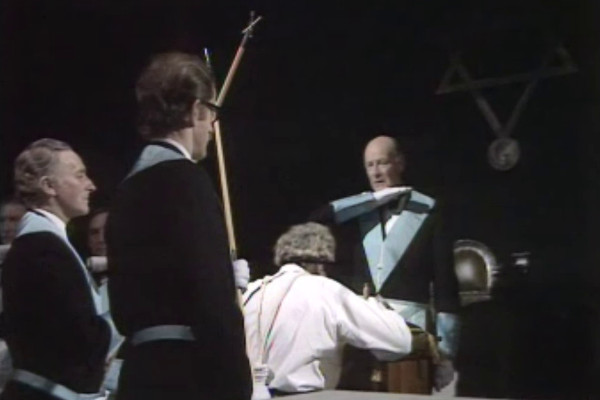
Brassneck was a 1973 stageplay by celebrated playwrights Howard Brenton and Sir David Hare. In Hare's own words, from his 1991 book Writing Left-Handed, then it was history seen: "[...] through the lives of the petty bourgeoisie, builders, solicitors, brewers, politicians, the masonic gang who carve up provincial England."
It's a clever conceit, starting in the then-present day, and then going all the way back to 1945 to see modern society being controlled. This does, however, force it towards the theatre of the absurd when Rogers Davenport and Lloyd Pack, both hovering around 30, have to dress as schoolboys in short trousers. Directed by Mike Newell, it's a decent piece, nicely satirical, and the use of changing times does mean it fits the 1h 20m duration quite well.
Hare wasn't a particular fan of the television medium, noting in the same book: "My original feeling that standards were so low that it was not worth working in television at all were based on my early experience of videotape. The play is cast, rehearsed in a couple of weeks, then slung on through a three-day scramble in the studio which is so technically complicated and so artistically misconceived that excellence is rarely achieved except by accident. The eye is always on the clock."
Of Brassneck in particular, Hare stated: "My own last memory of the recording of Brassneck was of leaving the box forty minutes after 'time' had been called, with an unrehearsed scene of a hundred extras and four unplotted cameras still going on chaotically downstairs, and the director crying helplessly to a random cameraman. 'Go in, Number Four, anything you can get.'"
Such a feeling informed Hare's other ventures with Play For Today: though he'd written for Series Three (the wiped Man Above Men), when he wrote scripts for Series Eight and Ten he stepped behind the camera and directed them himself.
As can be gleaned by the picture quality of some of the images in this article, Series Five of Play For Today hasn't been made widely available for the public to buy. Gangsters appeared on the Gangsters DVD Boxset, Sunset Across The Bay was on the Alan Bennett at the BBC DVD Boxset and Just Another Saturday has appeared on DVD as part of The Peter McDougall Collection DVD boxset.
Only three episodes have been released on BluRay to date: Funny Farm appeared on Dissent & Disruption: Alan Clarke at the BBC Bluray Boxset, Back of Beyond was one of the episodes on the Play for Today Vol. 1 BFI Bluray Boxset, and Just Another Saturday got a second physical release as part of the Play for Today Vol. 3 BFI Bluray Boxset. (All highlighted links lead to The Anorak Zone's partnership page with Amazon if you want to buy them.)
The others I've been able to get decent copies of from streaming platforms, apart from The Death of a Young Young Man and Breath, which, as you can see from their respective screenshots, are only available as very low res copies. (Though thanks goes to those who uploaded them, regardless.)
Such things shouldn't make any difference to the ranking, as this is a subjective assessment of the episodes based on things like script, concept and performance. Yet while it shouldn't make a difference, it's hard not let such things sway you, even if only unconsciously. After all, if you're watching an episode that's in pristine condition on BluRay, you can clearly get more immersed into the story than one that looks as if it was shot on film made out of clay.
Would Breath be likely to top this list if it were cleaned up and released on BluRay? No, not really. While it might rise a couple of places when you can really see it, it's an oddly unfocussed effort, that doesn't really come off. Angela Pleasence plays a pregnant wife who has breathing difficulties, which isn't helped by the arrival of a sinister home help, played by Liz Smith.
Is Smith's "Mrs. Pritchett" really a malevolent presence, out to do harm to Pleasance, or are scenes with her showing callous behaviour all in her mind? This article has tried to avoid spoilers as much as possible, but this one doesn't really give any concrete answers. Maybe that's intentional, in that you have to make up your own mind, but it does feel like it's missing an ending somewhere along the line.
Writer Elaine Feinstein barely referenced this work in her autobiography It Goes With The Territory: Memoirs of a Poet (2013), but did write about personal circumstances that no doubt inspired it: "[...] in 1975, the same year I gave up cigarettes completely, I developed asthma. It was seasonal, probably related to my childhood hay fever, but far more terrifying. It set in early that year. At night, I had to prop myself up on pillows, wheezing, fighting for breath, afraid of sleep. Our GP gave me a Ventolin inhaler, and I puffed. But the relief was short."
It's natural to look at runs of any TV show as collective "blocks", dictated by the episode listings, but this wouldn't have been the case for viewers at the time. After Just Another Saturday aired on 13th March 1975, Play For Today went into a run of the BBC's habitual repeats. Four plays from Series Four were shown, before coming back with Child of Hope on 24th April 1975.
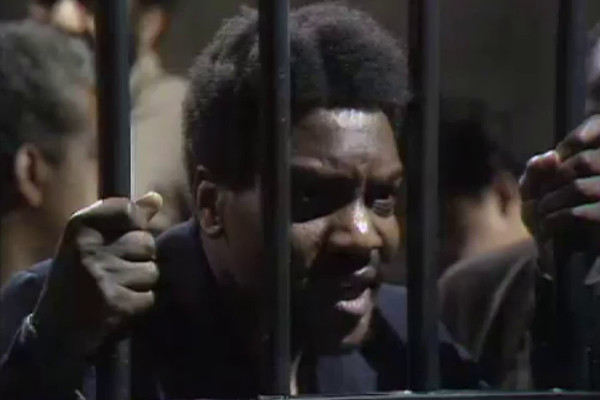
Based on the book No Neutral Ground by lawyer Joel Carson, this is a bleak return for the series, described in The Times the following day as "... unforgettable television which may have nothing to do with entertainment...". It's an accurate assessment, as the play, while done on the cheap, features political prisoners in South Africa being tortured. Watching a man being kicked between the legs sixteen times and then fitted with electrodes isn't easy viewing, although the very artificial nature of events takes away some of the edge, as well as the distance of time.
A commendable part of the production is an attempt at authenticity. Rather than getting English actors to put on African accents, then of 27 credited cast members, at least 17 of them were born in Africa*. Then there's Nigel Hawthorne, born in Coventry and putting on an accent, but as a child was raised in South Africa.
Now, this doesn't quite make it completely "authentic", given that Africa's a massive continent, and most of the characters were born in what was then called Ovamboland, now known as Namibia. This would be over 1200 miles away from South Africa, where the majority of the cast were born. This said, many of the legal characters do come from South Africa, and having any kind of genuine African accent has to be prefable to an English actor "doing the voice". They made a serious effort.
A Child of Hope is a propaganda piece, sometimes overtly so, as characters deliver chunks of exposition direct to camera to inform viewers what's going on, or narrate over the top of the action. And, as said, it's certainly not an uplifting watch. But it's a worthy piece, and should arguably have been ranked even higher on this list.
* It's very, very likely that it's 21 cast members out of 27. However, 4 of the minor players just couldn't be conclusively traced no matter where I looked, and I didn't want to give you unverified information. But I promise I spent hours looking through archive newspapers, sadly to no avail.