

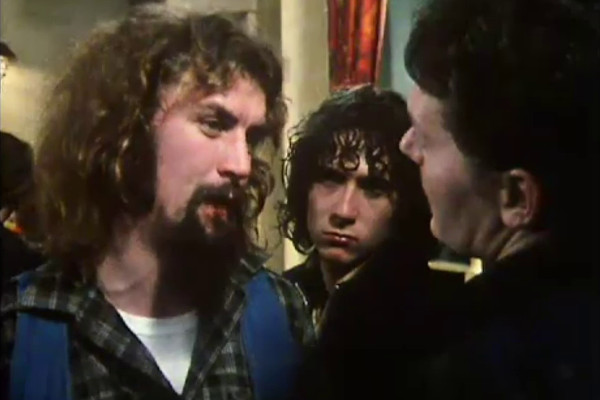
Although some of these plays have been repeated even fairly recently, there were five episodes from Series Five that got fairly immediate repeats in August-September 1976: Back of Beyond, Leeds United!, Sunset Across the Bay, Gangsters and this one. It's perhaps not much of a surprise here, as this edition won the 1975 Italia Prize for Television Drama Programmes.
Jon Morrison (credited as John) plays the baton leader of an Orange Order band in Glasgow, but gets disillusioned by the violence he sees on the streets as a result. One of the supporting cast is the aforementioned Billy Connolly, and he and Morrison have such a good chemistry together they were paired again in Play For Today for Series Seven's Elephant Graveyard.
There are always difficulties getting plays with political points over on television, in that they require the characters to be verbalising the subtext to each other in a way that can seem artificial. But this one does well with a balancing act, and scenes of violence - sanitised and artificial by today's standards, but still quite repellent - make it seem more than a play that wants to preach. Another oddity is that some of the crowd scenes feature weans - er, children - looking into the camera. This isn't just cinéma vérité style, but kids seemingly actively wanting to disrupt things by smirking on camera, and the production team not being able to retake, instead needing the public scenes "in the can".
The BBC Programmes Complaints Commission adjudicated on seven cases during the 12 month period when this play aired, with three of the cases about features on Nationwide. This episode of Play For Today was one of the other four cases, with the BBC Handbook for the period noting: "The Grand Orange Lodge of Scotland complained that a television play Just Another Saturday, shown in the series Play for Today on 7 November 1975, unfairly damaged the image of the Orange Institution and that members of the Order and of the Band who co-operated in the filming of the play were misled as to its real nature. The Commission upheld the complaint only to the extent that Lodge officials were in some degree misled by the BBC when their cooperation was obtained."
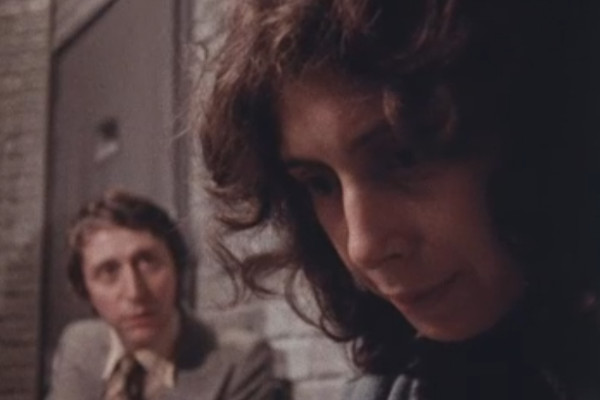
The high placing of this episode lies almost entirely on the absorbing, unglamorous performance of Patti Love in the lead role. Playing Eileen, a lady who kidnaps a baby after her own was stillborn, Love is, in many senses, greater than the sum of the play. Some of the other characters aren't that well developed, or some of the actors don't really bring out the right tone (Dev Sagoo as her boyfriend does often sound like he's reciting a learned script rather than really acting it, bless him) leaving it to the main actress to effectively carry it.
The episode was an adaptation of a 1973 stage play by the same writer, which also included Love in its cast. Transferred to a different medium and shot entirely on film, it can be stark and uncompromising. There were also threats of legal action as a real-life baby kidnapper was under the belief it was based on her.
There are concerns over the way the baby, played by James Noakes, is treated. This was many years before such things as "intimacy coordinators" and "safety advisors", and so the baby is genuinely distressed when a blazing row happens before him, while another scene has Love place her nipple in his mouth for "breast feeding". The unnecessary distress did not go unnoticed by newspaper reviewers at the time.
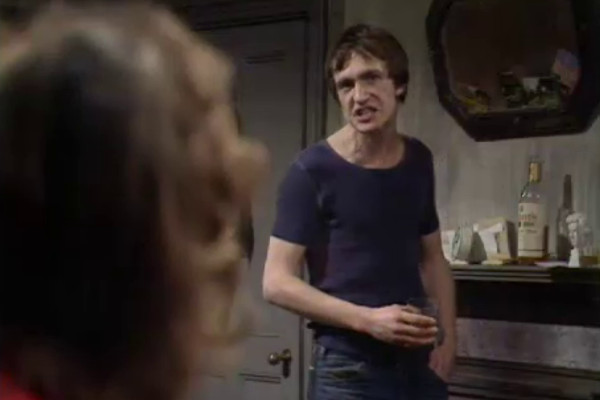
Two older women looking for cheap fun behind their husbands' backs enter a low rent drinking club and meet a couple of students. While one has a consequence-free fling, the other enters into a much more intense relationship with the deep natured Chris. (While the two women talk about how "old" and past it they are, they're only in their early thirties... they could be the Anorak Zone's daughters these days.)
Play For Today was reflective of the times, and so you'll hear sexism here, and also hear the racial epithet "p***" five times. But this play isn't to celebrate such matters, but to act as a sharp indicator of what the intellectual Chris (a predictably brilliant Simon Rouse) has to offer amongst such mundanity. There's also interesting subplots, such as Chris flirting with the affections of an old homosexual man in order to get free drinks, and his new beau being repulsed by it.
While Play For Today has been known to use fully licensed music - do you like a bit of Demis Roussos? - there are occasions in this fifth series where cheaper library music is used. This episode, in particular, has characters put on records and put money in a jukebox just to hear stock music that's less expensive to get the rights.
Put on the exceptionally useful App "Shazam" while watching this one and you'll find you're greeted with tunes like "Freaky" by Studio G. Strangely, another track used, "There's a Whole Lot of Loving" by Guys n' Dolls, isn't actually stock music, but sounds like it is. It actually made No.2 in the UK charts the same year this episode aired, but seems to have been generally been forgotten today.
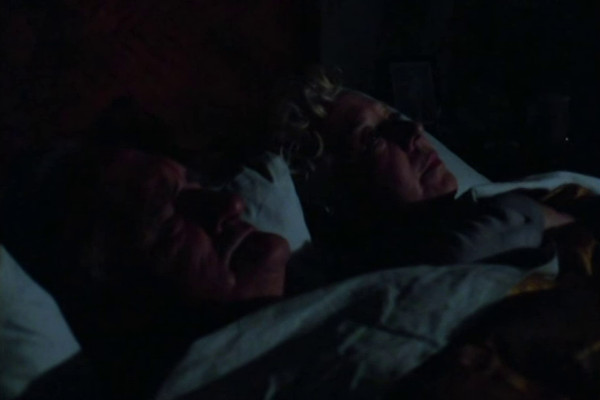
One of the bleakest, most depressing plays in the entire run, though such things do not dim its brilliance. This was the second TV play by Alan Bennett, featuring an elderly married couple based heavily on his parents.
Having retired to Morecambe from Leeds, the couple find their new freedom full of uncertainty and contemplate their own mortality. And - spoiler - it ends with the death of the father. Once writing was complete, but before production had commenced, Bennett's father died of a heart attack. In his 2003 book Me, I'm afraid of Virginia Woolf, Bennett noted: "Anyone who writes will be familiar with the feeling of involuntary prediction it sometimes involves, so having written my father’s death I felt I had helped to occasion it."
What makes this such a strong play is not just Bennett's customary observed writing, but the central performances by Gabrielle Daye and Harry Markham. Incredibly realistic, at no point do you feel you're watching a pair of actors, but instead a genuine married couple wondering what to do with the rest of their existence. It's perhaps this naturalistic tone that makes it strike even harder.
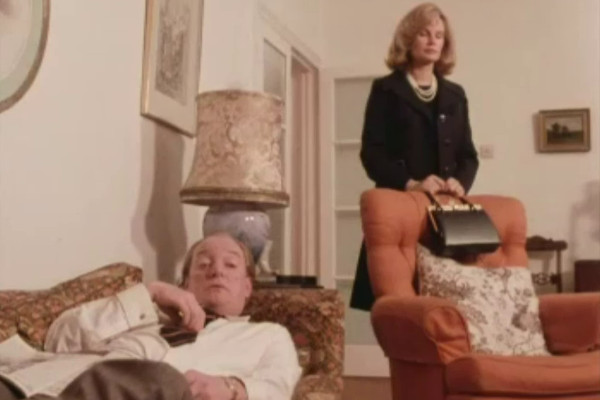
An exceptional black comedy about a marriage disintegrating through indifference. Jeremy Kemp (who also had a supporting part in this series' Brassneck) plays a generally sympathetic part about a man who has bored his wife out of their marriage.
Although this is Play For Today in a world of bowler hats and men calling each other "old boy", it extends beyond such trappings. What really makes it work is not just the fine lines and the strong supporting cast (including Clive Swift and Geoffrey Palmer) but the unrelenting darkness at the heart of the piece.
There are shots of a disabled child in a wheelchair being helped up stairs by his parents as discordant music plays. It's not altogether entirely clear what the purpose of the scene is, or its later reprise in the lead character's dreams: is he just feeling guilt over his own comparatively small worries, or is it something more? The couple have a son who gets referenced, but we never see him.
The play was based on a 1966 novel of the same name by William Sansom, who described the scene in print as: "[...] a couple passed wheeling their hydrocephalic child: both the parent's faces were smooth and unlined with care, the legacy of years of gentle quiet devotion. He felt his own troubles shrink, and despised the smallness of the marital world."
Much more can't be said about this one without revealing too much about the plot. But underneath a standard "marriage falls apart" situation is something frequently offbeat, perplexing, and faintly harrowing.
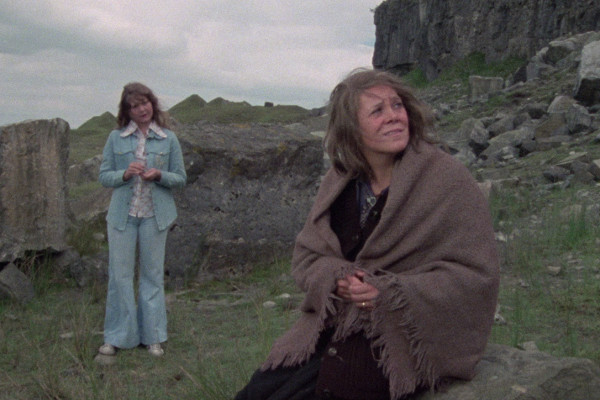
Back of Beyond is set amongst remote Welsh countryside, where a reclusive Olwen (Rachel Roberts) lives alone after the death of her husband. She's befriended by a schoolgirl, Rachel (Lynne Jones), who delivers her newspapers. It's a mesmerising play, where the environment is almost a character in itself.
Only two of the plays in this fifth run have been watched more than once here at The Anorak Zone (Eleanor and Gangsters), so it's unknown if a second watch of the run would push things around. While quite haunting to look at, Back of Beyond is propelled forward by the need to know what happens next. It's possible that this means it wouldn't stand up to repeat viewings, but I doubt it.
Speaking of the ending, spoilers have tried to be avoided as much as possible in this article, so we won't go into it. But there's an odd choice to let the final shot be a reflection of the eyes of Rachel's father (Edward Hardwicke) in the rear view mirror of his car. Is this just a coincidence, or subtly suggesting he had more of a hand in events than we're led to believe?
Roberts has a haunting quality to her as the lonely Olwen, and sadly it was reflected in her real life: she committed suicide six years after broadcast.
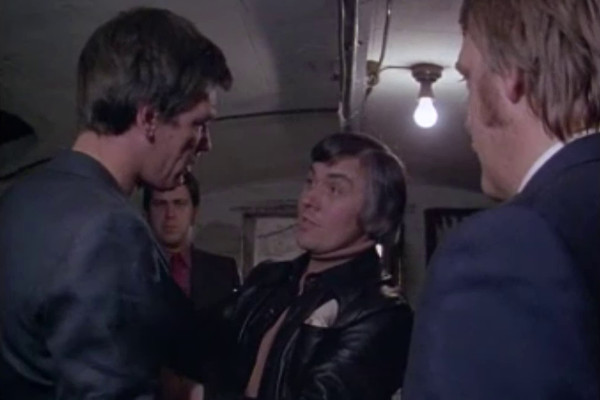
Magnificent, multi-layered crime drama that showcases a multicultural drug and extortion ring in the underworld of Birmingham. Despite being the second largest city in the UK, Birmingham has rarely been regarded as a "glamorous" location to film in, perhaps largely due to the accent, a it? With this in mind, Gangsters was a rare, pre-Peaky Blinders foray into a city which was more famous at the time for Crossroads than a Bollywood/western mash up set around the ring roads.
While Play For Today should be celebrated for its very old school, theatrical roots, Gangsters is the opposite, an action-orientated drama that revels in its modernity. Of course, said "modernity" is modern for the time, and there are multiple racial slurs which would be unlikely to air today. However, with the majority of them presented as jokes delivered by stand-up comedians, it also acts as a commentary on society of the time.
If there's perhaps one criticism of this fine piece, it's that it's very much a man's world depicted onscreen, with the two significant female characters existing more as plot mechanisms rather than fully fleshed-out personalities. But it's a small point, and the nature of the play dictates the environment.
The episode produced a spin-off series that was almost as good, as the whole thing had its own Gangsters Article on the Zone in 2016.
If you'd like to buy me a coffee for this research into Play For Today, then the button is below, but if you don't... that's fine, too, and I hope you enjoyed the article.