

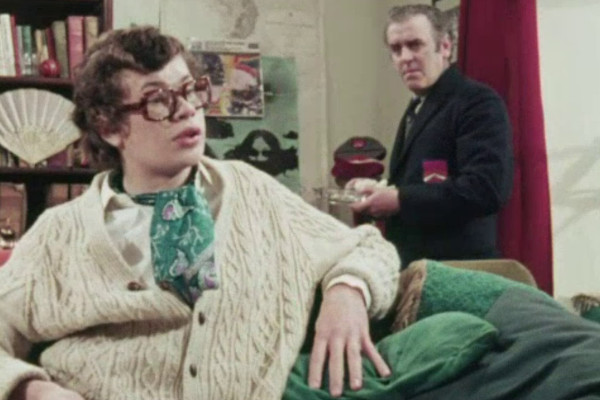
George Cole stars as a man who wishes to improve his social standing and education level by enrolling himself and his wife in an all boys' public school. Although his lack of education is explained (the war disrupted his studies), the entire premise is, of course, ludicrous and so must be looked at purely as satire. What help is the always-reliable Cole and the script by respected playwright John Osborne, plus the amusing chemistry between Cole and Christopher Witty as the schoolboy head of house ordering him around.
George Cole gave a fleeting reference to the work in his 2013 autobiography The World Was My Lobster, generally describing the basic plot, then noting: "In reality, it was difficult for the producers to find a school prepared to accept the disruption that would inevitably result from the extensive location work necessary. I think there were also some concerns from the schools that the finished product might project a less-than-favourable view of present-day public-school life. Their concerns were unfounded, however, and the end result was generally well received and provided an amusing look at class values in the early 1970s."
Shot entirely on film and location, the play looks striking, and there's no attempt at send-up with such a surreal idea. Yet Osborne wouldn't take calls from producer Irene Shubik after it had aired in October 1970. When it was repeated the following year, he sent her a card, with Shubik recalling: "Seeing Right Prospectus again,' wrote Osborne, 'I was struck by the care and skill that had gone into it. Also the very strong and sustained lyricism, regret and melancholy of it - simple and no jokiness. Just thought I'd tell you as I was a bit captious before and possibly ungenerous.'"
In Plays and Players Magazine (December 1970) Stanley Price gave a less favourable write-up: "Osborne's The Right Prospectus got a lot of publicity mileage out of the fact that it was based on a dream. It started with a splendid basic idea - a middle-aged couple (George Cole and Evi Hale) decide to go back to Public School - after that it went absolutely nowhere and had absolutely nothing to say at considerable length. It was the first time on stage or screen I have found Osborne a really total yawn."
There was a gap of 63 days between this and the previous new episode of Play For Today. After Reddick had aired on 18th February 1971, the following week the slot was given over to a repeat of Robin Redbreast, which had suffered blackouts in some areas of the country during its first screening. In so doing, Robin Redbreast became the first of the series to be repeated.
Then followed what were dubbed "Seven Selected Plays", which included Scenes From a Family Life, a 1969 episode of the similarly-named BBC2 series Plays For Today. This run also included six repeats of The Wednesday Play: No Trams to Lime Street (1970), Mad Jack (1970), Wind Versus Polygamy (1970), Playmates (1969), Sovereign's Company (1970) and Season of the Witch (1970). Technically they became Play For Today episodes as they were all repackaged under the new title, but they're not included here. Then on the 29th April 1971 came this edition, which could arguably be a "new" series, as the Radio Times billed it as "The first in a series of new plays".
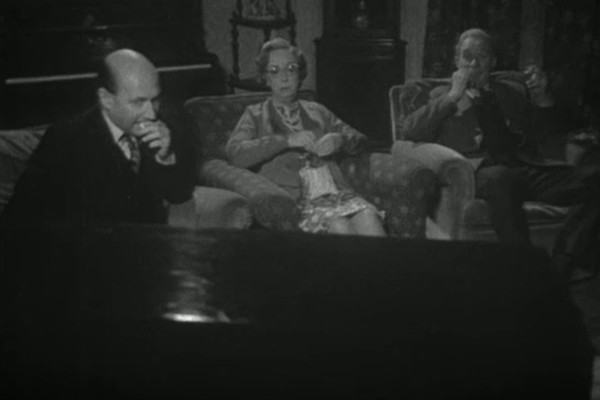
Featuring a relationship between Donald Pleasence, Michael Bates and Thora Hird, with the television playing an unnoticed commentary to their lives, it's a witty script that rewards more than one viewing. (It perhaps says a lot about modern society that we've dropped saying "ménage à trois" in favour of "thruple".) Crafted by Rhys Adrian, the writer had previously worked with producer Irene Shubik on The Wednesday Play, where he wrote the 1968 edition The Drummer and the Bloke.
With the first series, not only are there episodes missing entirely, but many of the others have bad representation in the archives. The Foxtrot was made on colour videotape, but this original source was wiped, and what remains in the BBC archives is a 16mm black-and-white film copy.
In the article on series five, it was discussed how it's almost impossible not to be swayed by low-quality copies when compared against higher definition productions.
Hearts and Flowers was the sole script by Peter Nichols for Play For Today, and was made on colour videotape. Unfortunately not only did it get wiped by the BBC, leaving just this black-and-white film copy in the archives, but the available copies "out there" are in a very low-res state.
It's a good play, with Anthony Hopkins heading up a strong cast, and does contain enough strength to rank this highly, even though it's like looking at a mud pile at time. You sense that, were it to be cleaned up a bit and publicly released - or, better, a copy of the original colour version found - then it would climb even higher up this chart.
The two Canadian plays in this first series were produced by Rudi Dorn and Mervyn Rosenzveig. Other than these two aberrations, the whole of the first series was produced by Irene Shubik (10 plays) and Graeme McDonald (11).
In looking back on Play For Today, we are particularly blessed with Shubik as she wrote an autobiography of her time in television, the aforementioned Play for Today: The Evolution of Television Drama. In it we learn that she tried to get into television with a BA and MA, and got scraps of work in Canada thanks to a brother who worked there.
But her real break came in 1960, where she'd submitted a script that got in the hands of the head of the drama department of ABC, Sydney Newman. Although he regarded her script as a "load of crap", he took her on in production, where she began as a trial story editor on ABC's Armchair Theatre.
While working for Sydney at ABC, Shubik had convinced him to let her put together a science fiction anthology show, Out Of This World (1962). The series was well-received, and when Sydney was lured to the BBC, he invited Shubik to join him, continuing her work as a story editor. She did so, but only on the proviso she could work her way towards being a producer. While Newman wasn't keen on her becoming a producer, she was eventually placed in the role for the BBC SF anthology series Out Of The Unknown (1965-1967*) and the psychological anthology show Thirteen Against Fate (1966).
While we've discussed elsewhere that Play For Today was essentially The Wednesday Play with a new name, what should also be acknowledged is that The Wednesday Play was really First Night (September 1963-May 1964) under a different name. Indeed, The Wednesday Play began with unused plays from First Night and its artier BBC2 equivalent, Festival.
Shubik didn't get involved with The Wednesday Play until quite late in, joining in 1967 after Sydney Newman had tempted her by saying she'd get chance to make productions on film. A major problem for Shubik was that the show at that time was being divided between herself and Graeme McDonald as producers, with clear lines between them: "It was agreed that both producers could not approach the same writer to work on the same programme; I was, therefore, prevented from working with such authors as David Mercer, Denis Potter and Hugh Whitemore and denied access to any scripts in existence."
A nice bonus of Shubik's book is that she listed the viewing figures for her ten episodes of this first series, with them cited as getting an average audience of 6.04 million. The highest from this period was Hearts and Flowers (8.15m) while the lowest was Everybody Say Cheese (3.25m). The Rainbirds was the next lowest from Shubik's ten episodes for this first series, with 4.45m viewers.
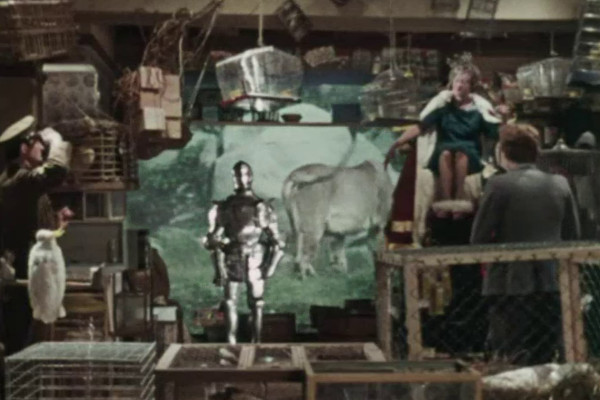
Challenging and uncompromising, the play is based around John Rainbird, a man who attempted suicide and experiences fantasy scenes while in a coma. Actual footage of Vietnam shootings and animal slaughter are played, while sequences such as the main character hung upside down in a slaughter house are depicted. It attracted varied reviews from the press, though, like many of these plays, rewards a second viewing.
As well as the press, Irene Shubik also had mixed feelings on the finished product: "To expect a television audience to cope with such a concerted attack on the army, the media, the medical profession, the Church and possessive mothers, all within seventy-odd minutes, is undoubtedly too much. The director compounded the crime by over-complicated technical feats (and sexual overtones of his own, introduced whenever I was away from the filming), which undoubtedly added to the confusion. Nevertheless, for thought content, The Rainbirds was a unique piece of writing and, in my personal experience a play, like all of [Clive] Exton's, which was remembered far longer than most."
* Out Of This World continued until 1971, the date range is the period when Irene Shubik was the producer.
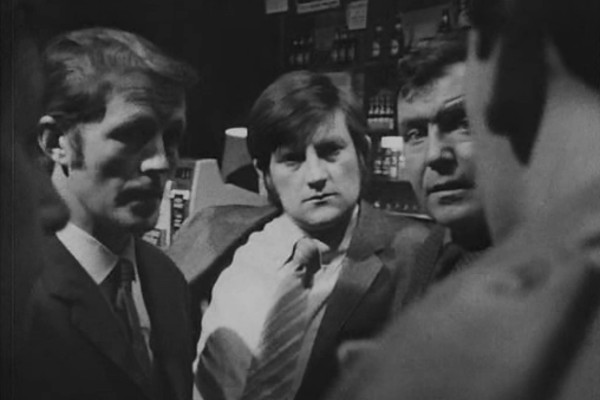
In 1968 writer Jim Allen was paired with the director Ken Loach (as "Kenneth Loach") for The Big Flame, a mock-documentary about striking dockworkers. To add to the naturalism, many of the supporting cast members were untrained actors with limited experience, and the film went out as an episode of The Wednesday Play.
Fast forward over two years later and Allen and Loach made this mock-documentary about striking glass workers, this time directly inspired by a real strike. It contained many of the same cast members (thirteen in total, at least from the credited cast) though it's interesting how some cast members worked their way up the listings between the two. Billy Dean had a small part as a barman in The Big Flame, but gets second billing in this. (He went on to work extensively in television, though would perhaps go on to be most known as "Harry Cross" in over 330 episodes of Brookside, by which time he was credited as Bill Dean.)
The Rank and File is perhaps best watched in isolation, as it is very much "rinse and repeat" of the earlier play in many ways, though is no weaker for it. In the 1998 book Loach On Loach, Ken Loach was quoted as saying that The Big Flame was the better of the two in his opinion: "I think my work was a bit better, although it had the same sort of elements in it. But I think the script of The Big Flame was stronger."
Featured in a first series where four of the existing episodes are in black and white, this is the only one of the four where it's supposed to be, as The Rank and File was - like The Big Flame - deliberately shot in black and white for artistic reasons.